The initial project
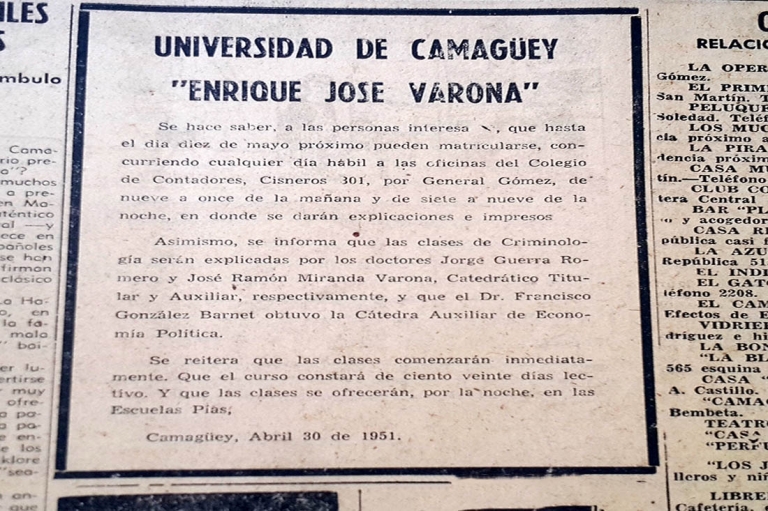
In the then Municipal College of Accountants, I quote in Cisneros no. 301, by General Gómez Street, would begin the enrollment process for a new university in the country, right in the province of Camagüey.
The registration price would be 30 pesos, being mandatory to pay 10 when submitting the application. Enrique José Varona was the name proposed for the university center, thus honoring the memory of the outstanding Camagüey intellectual on the centenary of his birth.
As of April 24th, 1951, from nine to eleven in the morning and from seven to nine at night, every day, except Sundays, the registration process was available to those interested.
The aforementioned university planned to teach nine specialties, of which four required a Bachelor’s degree as a requirement: Law, Business Sciences, Philosophy and Letters and Social Service, which they would graduate as professionals.
While the specialties of Music Sciences, Physical Education, Administrative Career, Pre-engineering and the Language career: English, French and Italian, the premises were, 17 years old and the title of Secondary or Special Education, which would culminate, to my judgment, equivalent to senior technicians.
The school year would have 120 school days, classes would be taught in the evenings at the then Escuelas Pías (today the Inés Luaces educational center) with six hours a week from Monday to Saturday. The first board of directors was formed by Dr. Ricardo Ríus, Professor Luis Guerrero, Daniel Rivas, Blanca Leyva TS, Ing. Ubaldo Arteaga, Oscar E. Socarrás, Dr. Norman Bretón, Dr. Humberto Figueras, Professor Tillo Acosta, Antonio Figueras, Dr. Rosa Peyrellade, Mario A. Betancourt, Dr. Carlos de Varona, Engineer Fernando Subirats, Manuel Manén, Dr. Jesús Centeno and Dr. Manuel Betancourt.
The process is extended…
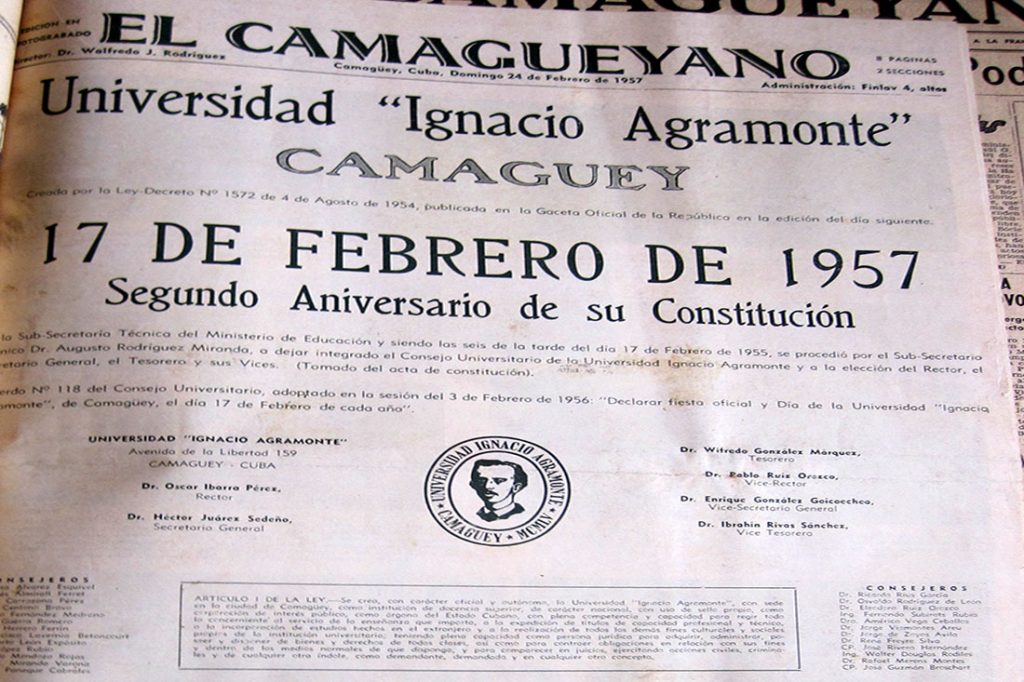
However, on August 4th, 1954, the Official Gazette published the creation of the University with a new name: Ignacio Agramonte – the first in Camagüey – based on Decree Law 1572. However, on February 17th, 1957, on the occasion of the second anniversary of its constitution, the organization of the University Council is published with the election of the rector, the general secretary, the treasurer and their vice-presidents.
In this context, the rector was Dr. Oscar Ibarra Pérez, the general secretary Dr. Héctor Juárez Sedeño and the treasurer Dr. Wilfredo González Márquez, the academic space was located in Libertad Avenue, no. 139.
Training components
Its training components, 15 schools, including Electromechanical Science and Engineering, Industrial Chemical Engineering; Agronomic and Sugar Engineer, School of Applied Arts, Philosophy and Letters, Commercial Sciences, Economics and Business Management, Pedagogy, Social Assistance, Social Sciences and Public Administration, among others.
Another of the components established in the Camagüey university system were the Institutes, such as the Research and Audiovisual Services Institute; the Directorates, for example, the Technical Directorate of exchange and university Extension and the Departments.
The university protected by article V of the Law, could issue titles of doctor, engineer, graduate, technician, expert, accountant, professor, executive secretary, social worker, trained and public seller; which should be sent to the Ministry of Education to be visibly and appropriately stamped.
Article XIX modulated in equal conditions the universities of Havana, Villa Clara, Oriente and from its creation the one in Camagüey.
Although from its first steps to this date there was solidity in the intention of endowing Camagüey with university, certainly its stability was not sufficiently sustained.
With all the components of Cubanness, a new university
After the triumph of the Cuban Revolution in 1959, the nationalization of educational centers promoted structurally free and inclusive educational practices from multiple angles, never before imagined.
From these new premises, the University, Ignacio Agramonte Loynaz, was established in 1967, accredited as the first university founded by the revolutionary process.
Present Day
By 1975, it was officially declared by Law 1294 of the Council of Ministers. One of the challenges has been the integration of the existing University of Camagüey “Ignacio Agramonte Loynaz”, with the University of Pedagogical Sciences “José Martí” and the University of Physical Culture and Sports Sciences “Comandante Manuel Fajardo”, of the Camagüey province, approved by the Council of Ministers of the Republic of Cuba in June 2014.
It stands out for its teaching composition of 10 faculties, 53 careers and 117 projects, more than 23 honorary chairs, with more than 12 thousand students and is attached to the Ministry of Higher Education. Professionals from different countries have graduated from this institution, from other provinces and municipalities of the country. Distinguished for the academic scope of its graduates, teachers and directors.
Bibliography
Periódico El Camagüeyano (1951-1959).
Sitio en Internet de la Universidad de Camagüey: Ignacio Agramonte Loynaz.
Translated by: Aileen Álvarez García