A street with his name perpetuates his door-to-door journey in that area, to collect coins that would allow him to improve the San Lázaro leprosarium and the construction of the Jata bridge, which today connects over the Tínima River the Havana Square with the Central Highway.
In search of this fascinating story, I went to the current Chapel of San Lázaro, to look closely at how much this special being is remembered, who is neither Blessed nor Saint, but he left us the best lesson of what charity and love are to the neighbor. We approach Father Valencia.
The legend
Among the many legends that surround the old town of Santa María del Puerto del Príncipe, today Camagüey, a well-known and somewhat forgotten story is that of Father Valencia. A religious of the Order of Saint Francis, his spirit is associated with the appearance of the white vulture in the Chapel of Saint Lazarus, where he put all his energies and good wishes.
Thanks to his tenacity and determined effort to help the sick and the population in general, life in this city took a very palpable turn. This was due to the construction of the Convent of the Ursuline Nuns, the Temple of Carmen, the Women’s Hospital and, above all, the San Lázaro Hospital, for the care of lepers, so precarious at the time.
All this work with the alms collected by the friar José de la Cruz Espí, or better… Father Valencia, as his parishioners called him, since he came from that Spanish region.
A successor: Father Paquito
After waiting for a baptism and the development of the Eucharist corresponding to that sacrament, I was finally able to reach the priest who currently officiates in the Chapel of San Lazaro, a faithful follower of the good works of Espí.
Father Paquito is a very simple man, his eyes express infinite kindness and he said he was happy that the life of this holy man was made known, who until 1838 lived and worked in that parish, leaving an indelible mark.
According to Paquito, the austerity with which Espí lived was moving, a bed made of boards and a brick as a pillow, which even today preserves the imprint of his head, for only four hours of sleep; they tell us about his sacrifices.
He also thinks that his spirit is alive in many good people, because as long as there are sick and elderly in need of affection and attention, there will be souls like Valencia to offer his hand.
The chapel
We continue our journey back in time through the usual routes of dear Father Valencia and we go to the small hermitage, where, separated by a wooden screen, the leprosy patients went to ask the patron saint for the miracle of their cure.
It is worth noting that between the years 1815 and 1819, before the demand of their Franciscan superiors for Father Espí to return to the city of Havana, within the order, the people of Camagüey asked the City Council not to leave the town until such a Christian work on the hospital had been completed.
The reasons were delayed and he never left this land, where he worked until the end of his days.
His death, which occurred in 1838 in his beloved parish, led to a two-day wake and then he was buried in that place that he loved so much. This is how Father Valencia remained forever, in the eternal place that he conquered with his humanist work.
A tribute to Father Valencia
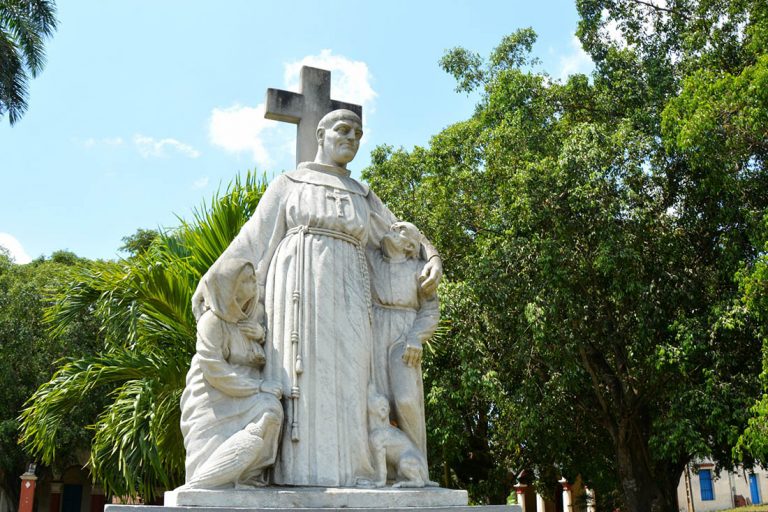
To perpetuate his memory and the countless tasks he undertook for the common good of Camagüey, on May 2nd, 1955, in honor of his birthday, a monument was inaugurated on the grounds where the white vulture perched, to remind us that in this city lived a special man, who from eternity returns as a legend and lives in the souls of those who care for the sick.
Translated by: Aileen Álvarez García