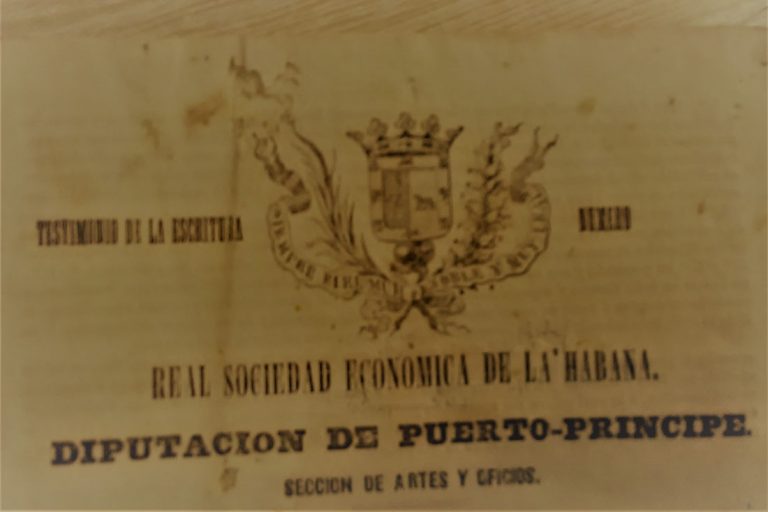
The need for a prosperous city, educated and free from social ills, had in the Patriotic Council of Puerto Principe its most faithful defender and architect, who through the actions carried out tried to raise the sociocultural level and the economic development of the territory.
Its emergence occurs as part of a historical context where the ideas of enlightened thought, spread by the main European powers and their colonies, had been channeled into the emergence of the Royal Economic Societies of Friends of the Country or the Royal Patriotic Societies, typical institutions of the Spanish and Latin American Enlightenment, from which the patriotic councils emerged.
In Cuba, a group of individuals belonging to the Creole and Spanish bourgeoisie, among which were: Luis Peñalver, the Count of Casa-Montalvo, Francisco Joseph Bassave and Juan Manuel O’Farril; they request Don Luis de Las Casas, Captain General of the Island, the creation of the Patriotic Society of Havana; which was approved by Royal Order of November 15th, 1792.
Since its inception, it was organized and structured by sections: science, education, agriculture, commerce, industry, culture, social studies, economic studies. In addition, it had statutes, which expressed the purpose for which it had been created: to promote agriculture and commerce, cattle raising, popular industry, and education and instruction. It is necessary to clarify that it had different names until in 1899 it began to be called the Economic Society of Friends of the Country of Havana.
Patriotic Council of Puerto Príncipe
However, the very economic development acquired by some regions of the country justifies the affirmation of the researcher Piñera, that from 1803 the process of founding the first Patriotic Provincials derived from the mother association began.
According to the scholar, they were institutions of a social nature, created in the 19th century, correctly organized and structured, attached as subsidiaries or dependencies of the Economic Society of Friends of the Country of Havana. Its main objective was to promote economic, social and cultural development in each of the regions of the Island where they were created.
In this way, on May 27th, 1803, the Patriotic Provincial Council of Puerto Principe was founded; which grouped in its ranks some of the most important and active figures of the period, among which the following stand out: Gaspar Betancourt Cisneros “El Lugareño”, who came to occupy the presidency of the Patriotic Delegation; Manuel de Monteverde y Bello, who in 1839 inaugurated the chair of Jurisprudence and Political Economy at “El Siglo” school, and Antonio Freire, founder of the newspaper El Fanal.
The actions carried out made it the most important during the years 1803 and 1820, as they exerted a great influence on the population, linked particularly to education and specifically to the foundation of public schools, through the creation of the section of education in 1816.
Education Section
Among the main contributions in this sector are: the creation and operation of the Academy of Mathematics; the preparation of the Navas Plan, which was the first document fully dedicated to regulating the development of educational activity in Puerto Príncipe; the care of black people in public schools, an aspect that is opposed to the legal provisions established by Spain that limited their access to schools; the foundation of the Royal Academy of Practical Jurisprudence “San Fernando”; establishment of free schools for the education of poor girls, attached to the Convent of the Ursulines; preparation and approval of the Official Teacher Regulation.
Industry and Commerce Section
On the other hand, the Patriotic Provincial Council of Puerto Príncipe, prioritized the establishment of the Industry and Commerce Section. Specifically, it organized the notoriety of the public livestock competitions and exhibitions that were held in the city during the 19th century. These events were initially held in the neighborhood of La Vigía, but from 1853 they were moved to La Caridad and began to be organized by the Board of the Casino Campestre.
Regardless of their exhibition and competitive objectives, they were also intended to stimulate agricultural production, through the assimilation and generalization of the most significant advances in science and technology.
Every time a fair was held, chronicles of the event were published in the local press. Some of these works came to constitute authentic works of scientific dissemination in the agricultural field. Among them, the one published by Manuel de Monteverde in 1858, the one by Ignacio Agramonte (father of El Mayor) and Joaquín Arteaga in 1865, the one written by Antonio Freire and the one written by Gaspar Betancourt Cisneros, a chronicle that has the merit of review the first of all the fairs that are held.
Undoubtedly, one of the most arduous tasks was the establishment of an iron road that would remove not only Camagüey commerce from its isolation, but also help agriculture and communications.
Thanks to the tenacity in the initiatives of Gaspar Betancourt Cisneros and accompanied by the landowners Luis Loret de Mola and Tomás Pío Betancourt, after being requested, the concession extended by General Miguel Tacón, governor of the island for the construction of a railroad that would connect Puerto Príncipe and Nuevitas. After several obstacles that made its realization difficult, it was not until 1851 that the 73 km extension of the 1837 project was completed.
Social Studies Section
The council through the Social Studies section sought to approach the needs of the population and urban planning. It dealt with the statistics of the city and its district; as well as the main evils that haunted society: poverty, destitution, vagrancy. As for urban planning, in 1835 he had the topographic plan of the city raised at his expense, and the following year its engraving and printing.
Arts and Crafts Section
With the Arts and Crafts section, among other things, the council proposed to incline the youth to the learning of both, in order to become better citizens. Thanks to this action, many poor children and adolescents, mostly black and mestizo, in many cases orphans, benefited.
A large percentage were practitioners of the trades of: shoemaker, carpentry, trade, tobacco shop, saddlery, barber-hairdresser, tailor shop, blacksmith, bakery, armory, among others. The apprenticeship lasted between 2 to 15 years and with it, it was intended that they acquire industrial and economic habits. In addition, it proposed to create a solid base of future workers and with their profession they would earn some money that would allow them to improve their situation.
Hygiene and Health Section
However, the mother society from its first moments dealt with the two fundamental epidemiological problems of the moment in the country: smallpox and yellow fever. For this, he founded the Central Vaccination Board and its respective Subaltern Boards in some of the main cities of the country, one of them being Puerto Príncipe, due to the importance of fighting these diseases in the different regions.
On the other hand, under its auspices, in 1834 the academy of midwives was founded, which was opened in a room at the Nuestra Señora del Carmen Hospital and its director was Dr. D José de la Cruz Castellanos.
The Provincial Council, although it had to face dissimilar inconveniences for the achievement and establishment of the projects, more than demonstrated the responsibility assumed for the socio-economic development and the cultural enrichment of Puerto Príncipe; hence its direct influence in the search for the potential of the territory.
Bibliography
Betancourt, Gaspar (2017). Escenas Cotidianas. Camagüey: Ediciones El Lugareño.
Luna, F. (2002). Cronología Camagüeyana 1514 – 1958. Camagüey: Ácana
Piñera, O. A., et al., (2009). Educación y Diputación Patriótica de Puerto Príncipe. Camagüey: Editorial Ácana. Cuadernos de historia principeña 8. Patrimonio legado al siglo XXI Cento, E. (2009).
Tamames, M. (2005). La ciudad como texto cultural Camagüey: 1514-1837. Camagüey: Ácana.
Torres Lasquetti, J. (1888). Colección de datos históricos, geográficos y estadísticos de Puerto Príncipe y su jurisdicción. La Habana: El Retiro.
Zanetti, Oscar y Alejandro García (2017). Caminos para el azúcar. La Habana: Ediciones Boloña.
Translated by: Aileen Álvarez García