The creation of an Institute of Second Education in Puerto Príncipe was granted by Royal Order on July 15th, 1863, which materialized on June 1st, 1864.
The initial teaching program included the following subjects: Castilian Grammar, Philosophy, Latin, Greek and Natural History. Elements of Arithmetic, Agriculture, Psychology, Reasoned Arithmetic, Algebra, Notions of Topography, Geometry, Trigonometry, Physics, Line Drawing, Bookkeeping, Applied Chemistry, Geography and Commercial Statistical Geography, Industrial Mechanics, French and English.
Greater attention to science is observed. Literature subjects do not play a leading role. Then it is in a letter to the Queen on October 26th, 1869 that it is requested to expand the Second Education with the subjects Religion, Sacred History, Mechanics and Industrial Chemistry.
A starting space
After analyzing the conditions of some buildings to establish the Institute, the infantry barracks were examined, the one built in plaza del paradero, the college of the Jesuit fathers, which today serves as cavalry barracks; that of the Fathers of the Pious schools, La Merced Convent. All these places are spacious, well ventilated, and are in the center so students can learn without the need of spending so much. The analysis concluded by recommending La Merced, due to its superior conditions to the rest of the buildings. For being the most expeditious and central.
Distinctive students in the colonial period
The first women in the Institute of Second Education: Herminia Agramonte Simoni (Daughter of Major Ignacio Agramonte y Loynaz and Amalia Simoni Argilagos) and Isabel Betancourt Castillo (1882).
Children of Major Generals of the Wars of Independence: Ignacio E. Agramonte Simoni (Son of Major Ignacio Agramonte y Loynaz) and José Francisco Martí Zayas Bazán (Son of the Apostle José Martí y Pérez) (1882).
First son of enslaved Africans in the Institute: Tomás Vélez y Vázquez (Son of Vicente Vélez Piloña and Luisa Vázquez).
The foregoing shows that without intending to do so, the Institute, in the academic year 1882-1883, constituted a stage that stands out as an example of social inclusion located in this place, where female students and an Afro-descendant son of former slaves concur for the first time within the student body.
A new building
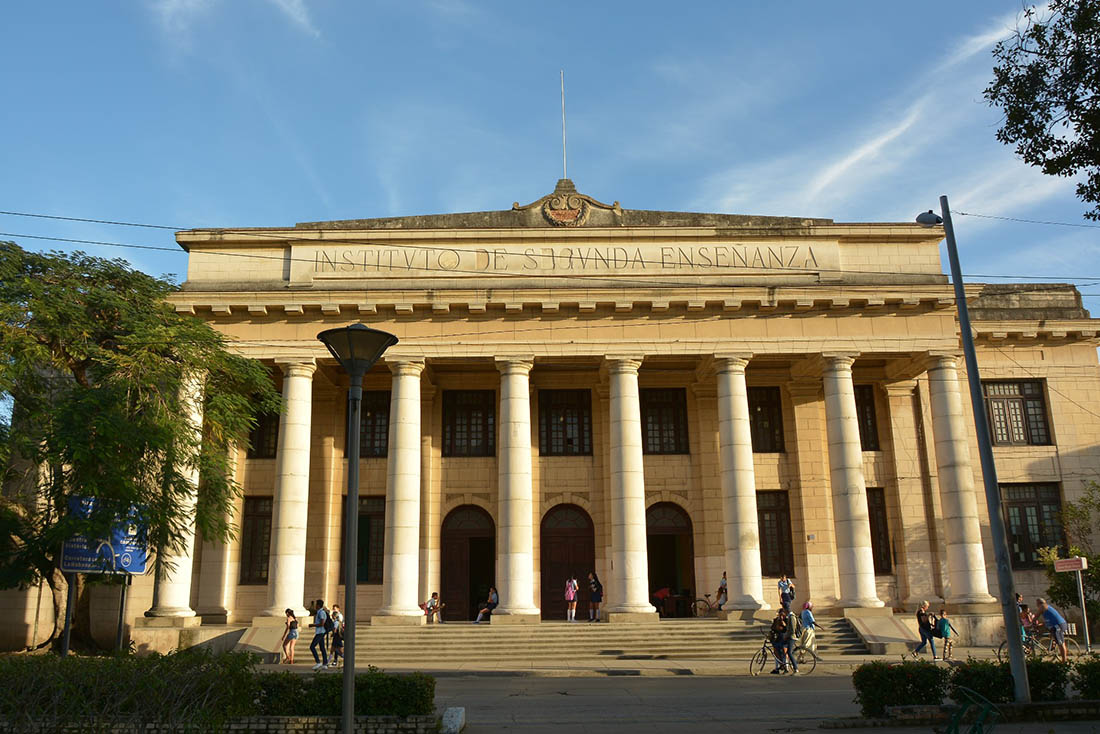
With an imposing eclectic building of marked neoclassical influence, the new Institute of Second Education was built in 1928, in the vicinity of the Casino Campestre.
The architectural codes chosen in remembrance of the Greek temples, perfect in visual equity, the voluminous Tuscan columns evoking the monumental modern and values of rationality linked to the tempo of the stairways, sociologically pointed from the structure to what was functionally developed inside: an association of knowledge.
Legacy
Nowadays, the Institute maintains the commitment to enhance academic capital. The Álvaro Morell Álvarez Pre-university is not only a symbol of educational achievements, but also of the promotion of altruistic principles of social justice and sovereignty.
Bibliography
(Archivo Histórico Nacional, Ultramar, Archivos Españoles) Expediente General del Instituto de Puerto Príncipe. Ministerio de Ultramar. Dirección General de Gracia y Justicia. (1867).
(Archivo Histórico Nacional, Ultramar, Archivos Españoles) Expediente General del Instituto de Puerto Príncipe. Ministerio de Ultramar. Negociado Instrucción Pública. Dirección de administración y Fomento. (1882)
(Archivo Histórico Provincial de Camagüey) Fondo; Instituto de Segunda Enseñanza.
Translated by: Aileen Álvarez García