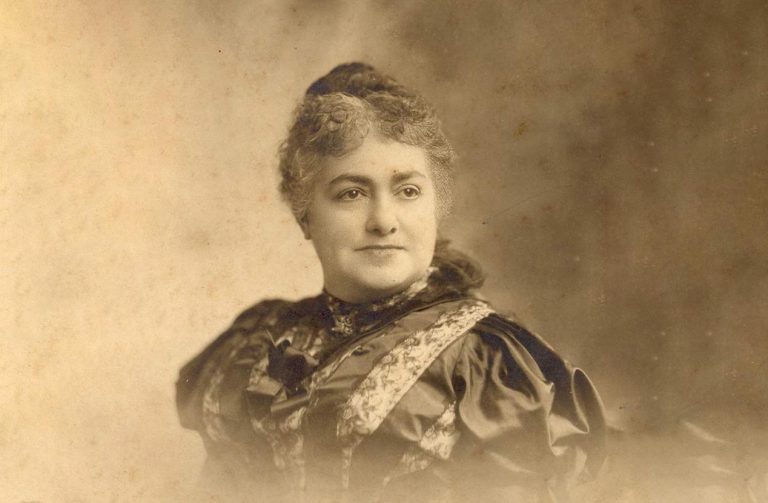
On December 22nd, 1910, one of the great women who exalted the history of our country, Ana de Quesada y de Loynaz, passed away. She was born into one of the most important castes of Puerto Príncipe on February 14th, 1843, with a great inheritance in livestock and related to the main families of the province, among them, those of Varona, Bringas, Castillo and Guerra.
Her father was Pedro Manuel de Quesada, a descendant of Silvestre de Balboa y Quesada, author of the poem “Espejo de Paciencia,” and her mother was Carmen Loynaz Miranda. She had five brothers, one of them was General Manuel de Quesada.
After the Guáimaro Assembly, General Manuel de Quesada invited Carlos Manuel de Céspedes to a meal at his house. There, the President of the Republic in Arms fell in love with the young Ana de Quesada. By then, Ana was 26 years old and Céspedes 50. From that moment on, Céspedes exercised that personal influence over her that characterized him. They would marry on November 4th, 1869, just months after they met, in San Diego del Chorrillo, Najasa, in the fields of Cuba Libre. Since then they are one force. Both had taken part in the Bayamo taking and were very clear about their libertarian ideas.
In July 1870 their first child was born, who was named Oscar in memory of the man shot by the Spanish. In September, Anita is taken prisoner along with her family and after releasing her they reunite with Céspedes: ¨And once I was reunited with my husband, I saw the life of my child disappear, who died due to inclement weather and the fatigue of those days when, endlessly persecuted, we walked from one place to another, without resources of any kind to take care of his illness and save him”.
Céspedes decided to send his wife into exile, and after leaving to catch a boat accompanied by the martyr poet Juan Clemente Zenea, they were taken prisoner. Shortly after, she was able to go to the United States. Twins Carlos Manuel de Céspedes y Quesada and Gloria de los Dolores de Céspedes y Quesada were born there.
In October 1873, after difficulties that arose in the Chamber of the Republic in Arms, they decided to dismiss Céspedes as President. He asked for a passport to be provided to him so that he would reunite with his wife and his children so that he could continue serving the revolution from abroad. The Chamber did not agree to this request and Céspedes withdrew to the San Lorenzo ranch, where, as is known, he met his death, in a painful episode.
After such eventful moments, the exile Ana only focused on one thing a: to prepare her son, Carlos, to serve the country when the war began again. Carlos Manuel de Céspedes y Quesada comes to Cuba on a great expedition, to the homeland that he does not know physically, but that he feels like his own because of everything his mother has told him about it. Ana is also part of this expedition, to accompany her son and rejoin the revolutionary struggles. Once independence from Spain was achieved, Ana de Quesada y Loynaz died in Paris, on the aforementioned date.
This is how a woman closely linked to the independence struggles of our country finds death. A woman who accompanied the preparations for the Yara epic, for the consummation of the heroic event of October 10th, 1868, also enjoyed the victory of the Bayamo taking and encouraged the burning of it.
Translated by: Aileen Álvarez García