The atmosphere of the place is suitable for a chat, although I prefer to remain silent and thus enjoy so much treasured history. The Railway Museum and its Historical Archives open their doors to share with two conservator-restorers who, precisely today, International Day of the Conservative-Restorer exchange stories with our team.
Anisleidis González Carmenates, between nerves and security, welcomes us to her environment, to the place where she feels at home.
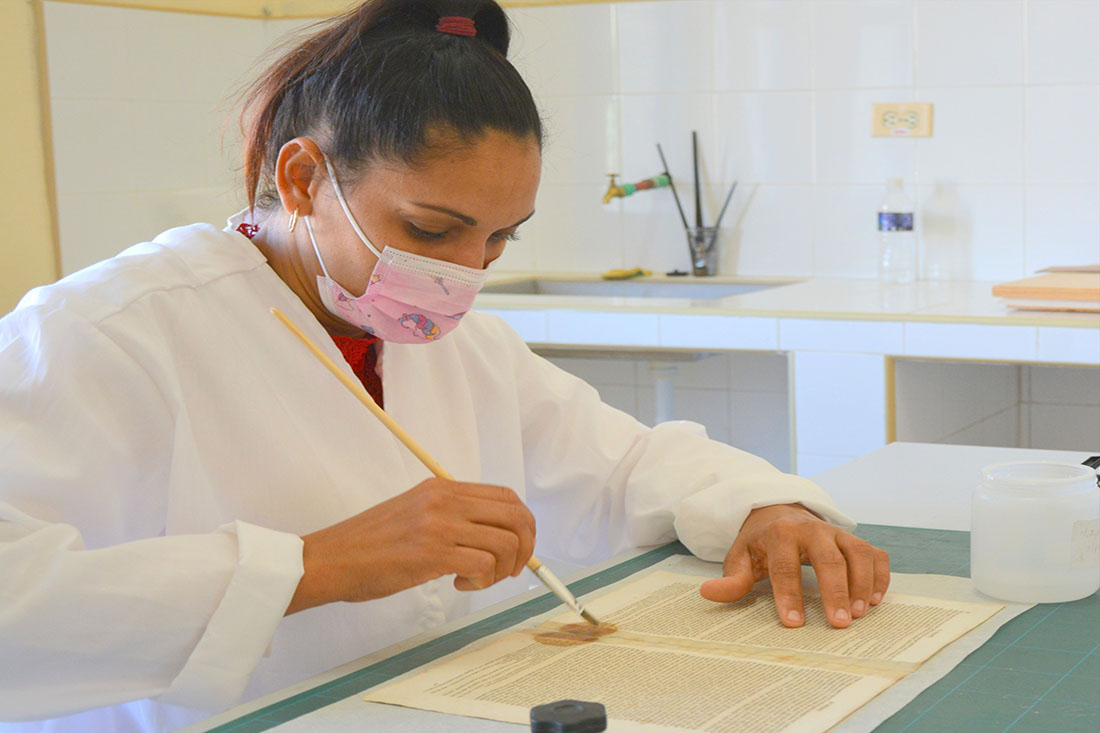
“Three years ago I restored documents with all the patience and care they deserve. It is a profession to which you have to give yourself, because you must like it. Every time I come to this office I am fulfilled. I don’t find one assignment more exciting than another; because each one has a magic that marks me.”
Between books, maps and letters Anisleidis does not stop in our conversation and it is time to know the particularities of the process.
“It depends on how the document arrives, it is decided if it is washed to present a color that time has taken its toll, it is dried, it is unbound, the pages are marked to organize their order and they begin to be evaluated. Some are treated with the methylselulose solution and tissue paper; while others undergo grafts. When the work is finished, they go to the warehouse so they can be consulted.”
Anisleidis treasures the experience of more than 16 restored documents; while she continues to give herself to her profession.
Digitizing is also preserving
Víctor Alejandro Landa Cruz, is a document digitization specialist at the Railway Museum; specifically from the Archive. Graduated from the Heritage Management and Conservation career, he feels really identified with his work.
“The conservator receives the document, makes a technical sheet of how it is recently delivered, and then in the digitization department, digitize it as it is; from there it goes to the conservation workshop and that is where the entire restoration process is carried out to avoid damaging the document in the slightest; in fact, preventive conservation is used to avoid touching the document. After being restored, it returns to the digitization department to expose how it turned out after the process, showing a before and after in his intervention. That readable copy after restoration is the one used to share with the public.”
The work of the conservator restorer is often anonymous, which is why Víctor’s opinion from the perspective of a recent graduate also counts.
“People from Camagüey like to have the history section well preserved, and it is there where the conservator restorer plays a fundamental role. Ask researchers when they have a very important document to consult and half of what is written is not appreciated, how much they need a conservator restorer; but without a doubt much is missing in the recognition of these professionals who pave the way for the best results.
“We must thank the Office of the Historian for having an archive that has a document restoration department, which has also been achieved with international cooperation projects and in which we do not stop for the preservation of memory of our city.”
We say goodbye to the Railway Museum with the certainty that its archive and professionals are the undisputed guardians of a city that keeps its past, present and future in the best hands.
Translated by: Aileen Álvarez García