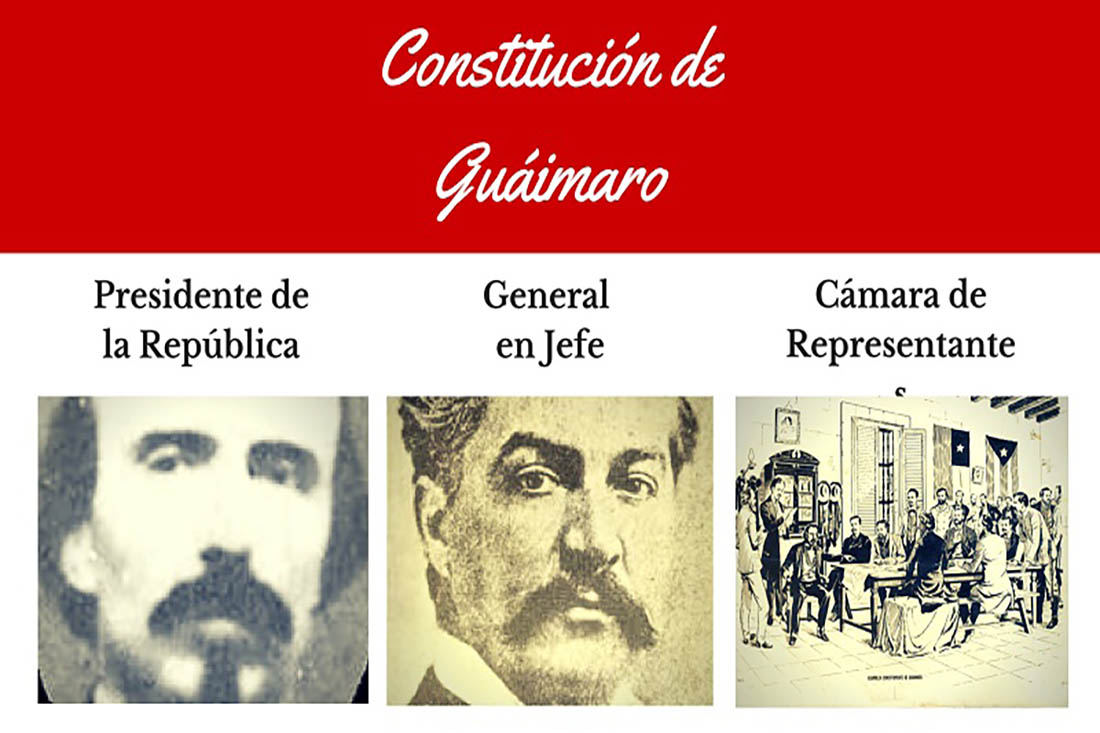
The Apostle, José Martí, pointed out: On April 10th, there was a meeting in Guáimaro to unite the two divisions of the Center and the East. That had taken the republican form; this one, military. Céspedes bowed to the form of the Center. He didn’t think it was convenient; but he thought dissension were inconvenient. He sacrificed himself -what no one does. (Volume 22, p.235).
The congregated elected Carlos Manuel de Céspedes as president of the conclave and as secretaries, Ignacio Agramonte and Antonio Zambrana, the latter a young intellectual from Havana included in the delegation from Camagüey.
The island was divided into four states: West, Camagüey, Las Villas and East. The legislative chamber was constituted by the representatives of the states.
It is highlighted that, it was not the number of inhabitants of each region that set the delegates, analyzes the researcher Rolando Rodríguez, since East quintupled Camagüey and surpassed Las Villas and the correspondence did not behave as is. In this sense, among the 14 constituents, the Father of the Nation was the only one of the caudillos who started the deed that was part of the eastern region. Camagüey and Las Villas brought together its most notable insurgents.
In addition, the Chamber would be represented by 10 delegates from the East, and five from the other three states, the votes of the latter being worth double those of the East.
The Assembly, the Constitution, the Chamber and the Unification…
The unification of the insurgents was the main achievement of the Assembly of Guáimaro, although it did not translate into a categorical unity. The division in the insurgent camp had its maximum expression in the deposition by the Chamber of the President of the Republic, Carlos Manuel de Céspedes del Castillo, on October 27th, 1873.
Then in 1875 a group of officers and civilians, around Major General Vicente García, pronounced themselves in Lagunas de Varona. In addition, the president of the republic was provisionally held by the same president of the Chamber, Salvador Cisneros Betancourt, since Francisco Vicente Aguilera was out of the country collecting funds. Researchers Eduardo Torres Cuevas and Reinaldo Suárez Suárez affirm.
This last aspect was fuel, among others, for the Santa Rita program structured by General Vicente García and proposed on May 13th, 1877 where he opposed the form of government established in Guáimaro. In the 2nd article, the sovereign powers that he had assumed were subtracted from the Chamber and placed in the people: “The sovereignty of the people will be the basis of the political organization of the nation.” Historian Olga Portuondo alleges that: The House of Representatives became what it had tried to prevent: the sole authority. I agree.
National values
The Guáimaro Constitution was the only one that governed Cuba between April 1869 and February 1878, although its validity only lay in the territories liberated by the mambises. Spain, for its part, continued to maintain and strengthen the All-Comprehensive Faculties of the captains general.
The first and most sacred right, and at the same time duty, was the defense of the homeland. They declared entirely free all the inhabitants of the republic and eliminated slavery.
Legacy
The universal Eusebio Leal pointed out, “…Guáimaro is at the base of the national republican sentiment, deeply pro-independence and anti-slavery in Cuba, and is the base and foundation of the constitutional and legislative system of the Cuban nation. “
Article 24
All the inhabitants of the Republic are entirely free.
Bibliography
Leal, Eusebio (2019) “Prólogo”, en Cuando la luz del mundo crece, Sesquicentenario de la Asamblea de Guáimaro (1879-2019), compilador Luis Álvarez Álvarez, Ediciones El Lugareño, Camagüey, Cuba.
Martí, José. (1975) Obras completas. Tomo 22, Editorial Ciencias Sociales, La Habana, Cuba.
Portuondo Zúñiga, Olga (2019) “Paradojas de la Constitución de Guáimaro” en Cuando la luz del mundo crece, Sesquicentenario de la Asamblea de Guáimaro (1879-2019), compilador Luis Álvarez Álvarez, Ediciones El Lugareño, Camagüey, Cuba.
Rodríguez, Rolando (2009) Raíces en el tiempo, Editorial Ciencias Sociales, la Habana, Cuba.
Torres-Cuevas, Eduardo y Reinaldo Suárez Suárez (2018) El Libro de las Constituciones. Constituciones, Estatutos y Leyes Constitucionales en Cuba entre 1812 y 1936. Tomo 1. Ediciones Imagen Contemporánea, La Habana, Cuba.
Translated by: Aileen Álvarez García