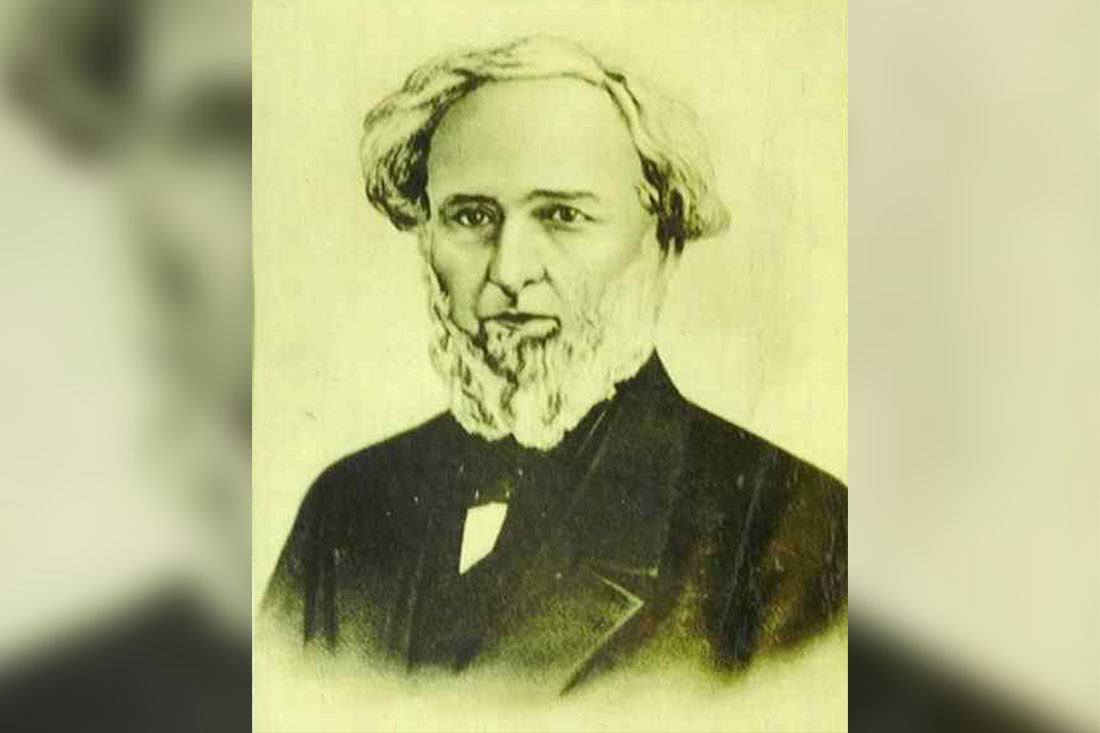
I don’t think there is a local personality in Camagüey so identified by his nickname as Gaspar Betancourt Cisneros, whom everyone recognizes as El Lugareño, which in his own words was how he wanted his countrymen to see him, despite the fact that he used other pseudonyms such as that of Homobono, Nose and the Man in letters to his friends and journalistic writings.
Betancourt was a member of important families in the principeña city, intelligent, cultured, educated, completed his intellectual training in the United States, where he assimilated the progress of the North American nation, believed in the annexationist solution to resolve the island’s colonial situation, just as in white colonization to end slavery and in progressive projects as development mechanisms for their homeland.
Between 1838 and 1840, the Gazette of Puerto Príncipe publishes the Daily Scenes -signed by El Lugareño- articles of a wide cultural, economic, social spectrum, which portray Camagüey through traditions, customs, culture and even local conservatism. His position defines the man from Camagüey proud of his land, but at the same time the staunch critic against what conspires against progress.
Undoubtedly, the direct, diaphanous, and controversial language in letters and the press shows the educated man, who obtained his designation as a partner of the Royal Economic Society of Havana in 1841 and a prominent member of the Patriotic Delegation in Camagüey, but also to the common citizen capable of connecting with all kinds of readers.
On the other hand, in the Cuban intellectual sphere of the nineteenth century he occupies a prominent place, the correspondence exchanged with thinkers of the stature of José de la Luz y Caballero, José Antonio Saco and Domingo del Monte.
His passion for the railway work
One of the most outstanding aspects of Betancourt was the determination and tenacity to make the Nuevitas-Puerto Principe iron road a reality. He obtained approval for the project, paid feasibility studies and other resources from his personal fortune, requested financial aid to complete the work, and through the press held passionate and accurate debates in favor of the company.
Finally, the long-awaited project in its first section became a reality on April 5th, 1846, the year in which El Lugareño had to go abroad by order of Captain General Leopoldo O’Donnell. The new stay in the United States of America and European nations constitutes one of the most interesting facets of his political life. He returns to Cuba in 1861, he settles in Havana until his death on December 7th, 1866.
There are little known énigmes related to Betancourt Cisneros; Among the first locomotives that arrived in Camagüey, one was named by engineer Wright as El Gaspar, but Betancourt himself changed the name to El Principeño.
However, in the minutes of the principeña railway company in 1866, money is requested for the repair of a locomotive that bears the name of El Lugareño, without specifying more information in this regard, which allows us to infer that a locomotive with his name, pending detail to investigate like others of the life of the man from Camagüey.
The whereabouts of the bust dedicated to Gaspar Betancourt located on the landing of the central staircase of the Railway Offices building is unknown, however, the plaque that marks his home on the street named after his pseudonym remains. The Ignacio Agramonte Provincial Museum has some exhibits related to him, including a painting made posthumously.
I do not only believe in monuments to immortalize the legacy of men like Betancourt, but I do not fail to recognize that his small homeland should and can pay him greater tribute. I am satisfied that, currently in the Railway Museum and interpretation center, there is a station dedicated to the history of the railway that bears his name, to recognize his value as a pioneer of this modern means of transportation in Camagüey.
Translated by: Aileen Álvarez García