With similar foundational budgets as the “Philharmonic” of Puerto Príncipe, enthusiastic about the cultural advancement of the enlightened Creole sector of the rich livestock region of Cuba, another city enlightened branch would focus efforts on creating the Santa Cecilia Popular Society, efforts that would be crowned with its emergence, on November 20th, 1864. Entity that Camagüeyans from the middle class and less affluent would integrate, «[…] but decent people from the principeña society, at the same time that it could receive the benefits of an elementary, superior and artistic, hold appropriate meetings and parties, thus strengthening the bonds of fellowship and promoting culture among its members.
About the origins of the Popular Society
Focused on that objective, their directive would set their sights on the house indicated with the number 1 of the Merced Square, which on September 4th, 1865 was in the possession of the spouses Manuel Agustín Molina Villavicencio and Ángela Molina Adán, then home with two floors and a tiled roof, with a cistern, waterpots and accessory pieces along the Mojarrieta alley, covering an area of 552 square metres, in the Merced Square.
Decisive meeting for La Popular
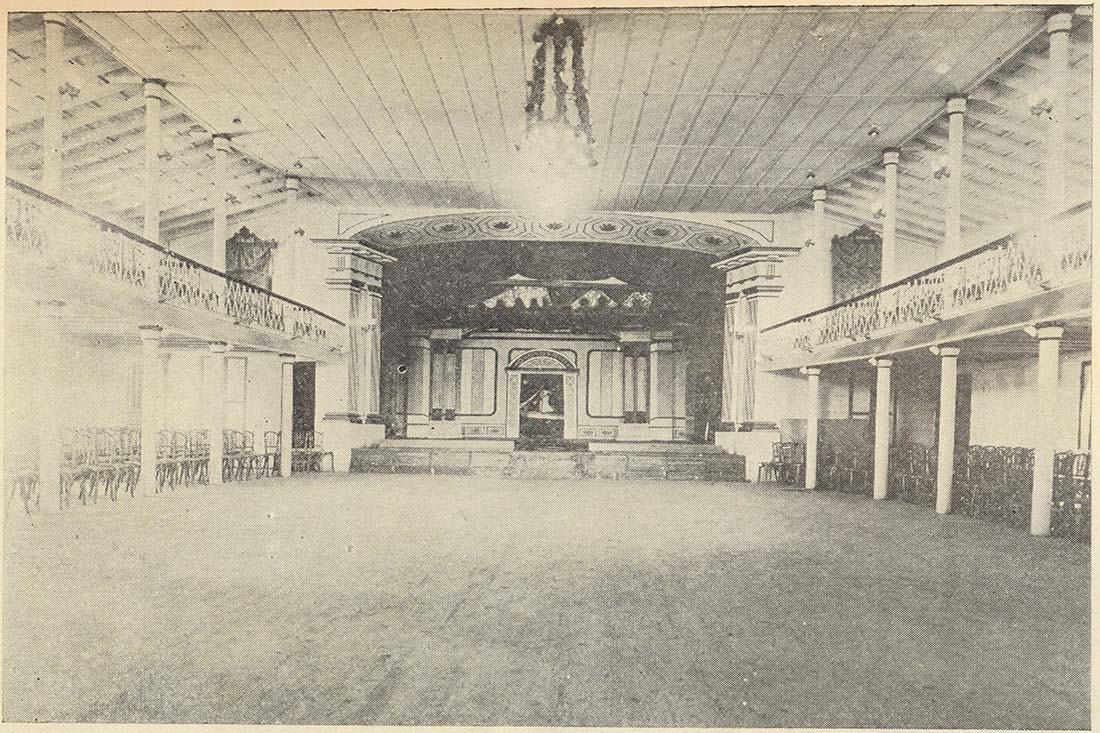
The meeting where the project would be approved took place in the boardroom of El Fénix theater, on November 22nd of that year, then in a small open theater in the La Merced alley that would have been leased by the Popular board. That day its members agreed to name it “Santa Cecilia Philharmonic Society”. On that occasion, some thirty members contracted the responsibility of promoting the culture of Camagüey’s society.
A fragment of the opening words of Lic. Juan Manuel García de la Linde would highlight: «[…] Let us unite and strive for the good of the Society, since it will also be ours; let us work and moralize ourselves eagerly, and let us make an effort so that we appear to the eyes of Cuba educated and sociable, because we achieve that, each model in their way of life, it is said that sensible people: “that individual so moderate, so educated, that … he is a son of the Popular Society».
Days of glory would come, of music classes and other artistic expressions by the cultists of the regional Parnassus. Meanwhile, on August 8th, 1899, the board of directors agreed to lease the house on Soledad Street marked with number 2, near Merced Square, to provisionally transfer the headquarters of La Popular there. Months later, on October 2nd, the board of directors proposed to the City Council the change of the name of the Merced alley to Popular alley, which would be authorized on the 27th and in that same street.
After negotiations, finally, the offspring of the Molina-Adán couple would sell the two-story house no. 1 to the president of the board Dr. Ramón Virgilio Guerrero Betancourt, on May 7th, 1926. The next step, -on January 16th-, the board would agree to demolish said house occupied on the ground floor by the Municipal Board of Education and build the “Casa Social de la Popular”, which would wear the eclectic style, which everyone would admire on the opening day, June 3rd, 1928.

Finally, on the day everyone had been waiting for, the representations of city entities and corporations gathered in front of the building that, without a doubt, would resignify one of the founding and structuring urban spaces of the old town of Puerto Príncipe. A year later, on the same date, the Ramón Virgilio Guerrero Theater was completed and inaugurated, “true Palace for Culture and Art”, as it was described by Dr. Ramón V. Guerrero. By the way, few people notice the details of the bars of the five windows along the Mojarrieta alley, where the letters B, S, P, de, S, C appear, the same ones of the Benemérita Sociedad Popular de Santa Cecilia.
A building that has gone down in history
The building in the Charles A. Danna or Workers’ Square, the work of architect José S. Acosta O’Bryan, is a landmark of eclectic architecture in the city. There was no other social-cultural work in any other city square that presented such uniqueness. Precisely, by highlighting the coat of arms of the city that was conferred by the Spanish monarch Fernando VII, on November 12th, 1817, that single element would raise its aesthetic value on the façade.
At the same time, the roof on the corner of the building would expose a turret ending in a dome supported by double columns. Round arches and basket-handle on the first floor enhance its entrance, from which a majestic marble staircase with decorated iron railings leads to the upper floors.
Made of top quality materials, the building would leave exposed marble, false ceilings with eclectic motifs, mosaic floors imitating carpets, bomb lamps, a central mirror covered in precious wood and luxurious furniture; everything as a ponderous set of an architectural work worthy of exquisite refined aesthetic taste and formal elegance. Undoubtedly, it would enter into an architectural dispute with the eclectic building of the Philharmonic Society, in the Ignacio Agramonte Park, and with other buildings of its historical time.
However, both El Liceo and La Popular would host distinguished personalities from the Cuban and international cultural universe, as well as musical groups, among others: the lyrical singer Adelaida Cortesi, Amelita Galli Curci, Adelaida Ristori, the tenor Hipólito Lázaro, the maestro and Italian sculptor Salvatore Buemi, Herminia Agramonte Simoni, Jorge Negrete, the master conductor Jacinto Barbosa, the famous teacher and caricaturist Conrado Massaguer, the composer Medardo Vitier, Benny Moré and his Giant Band, the Antillean Poetry Watercolorist Luis Carbonell, the singers Tito Gómez and the Riverside orchestra, Esther Borja, the vedet Rosita Fornés, the Cuban singers Pacho Alonso and Barbarito Diez.
Rehabilitated by the Office of the Historian of Camagüey city, in the midst of obstacles and barriers imposed by the US blockade on the Greater Antilles, its symbolic value of the building that would open as the Santa Cecilia Convention Center would be impaired. Undoubtedly, a paradigmatic building that preserves its symbolism within the local architectural repertoire, it cannot be otherwise, because it was the cultural society of Puerto Principe and Camagüey determined to make Camagüey one of the most cultured cities in the world.
Translated by: Aileen Álvarez García