Summary of the descriptive memory of the Designer Arq Humberto Delgado
Independencia Street is the old Candelaria. The dedication of La Candelaria has an essential place in the cultural history of this city, since only from it could the origin of its first settlers be understood and, what is more important, the roots of a way of being, of that regional essence that The El Lugareño called in the first quarter of the XIX “camagüeyanidad”.
As a toponym Candelaria carries information that goes beyond the urban fact. As a dedication it has its origin in the Canary Islands, from where it spread to the American continent and within it to Puerto del Príncipe on the north coast of the Island of Cuba.
Urbanistically, a key moment in the consolidation of the section was the creation of the convent of Nuestra Señora del Merced, a construction that defined two axes of high urban hierarchy from the 17th century: Cisneros and Candelaria. Remember that, until the first quarter of the 18th century, in the current Plazuela de Maceo, previously known as Paula, was the town hall building.
It is an axis that, given its centrality, it is continuously enriched. In 1861, a funeral agency, seven grocery stores, a bazaar, a barber shop, a confectionery shop, five hardware stores, a chocolate mill, two bakeries, a fur shop, two silver shops, a pawnbroker, two grocery stores, a watch shop, five tailor shops, a hat shop, eight lingerie shops and five shoe shops.
The skilled labor in the construction order is also the starting point for a tour of Independencia Street between Ignacio Agramonte and Plazuela de Maceo. In the first two decades, the Master Builders will be present, followed by the architects. The memory of the projects written by these professionals are true passages of the construction practices of the moment and of modern languages and even of the elements of fashion and aesthetic taste of owners and architects.
Given its urban hierarchy, it was among the first in the process of renaming its name when it was renamed Independencia by agreement dated February 13th, 1899.
Independencia Street in the context of the urban fabric
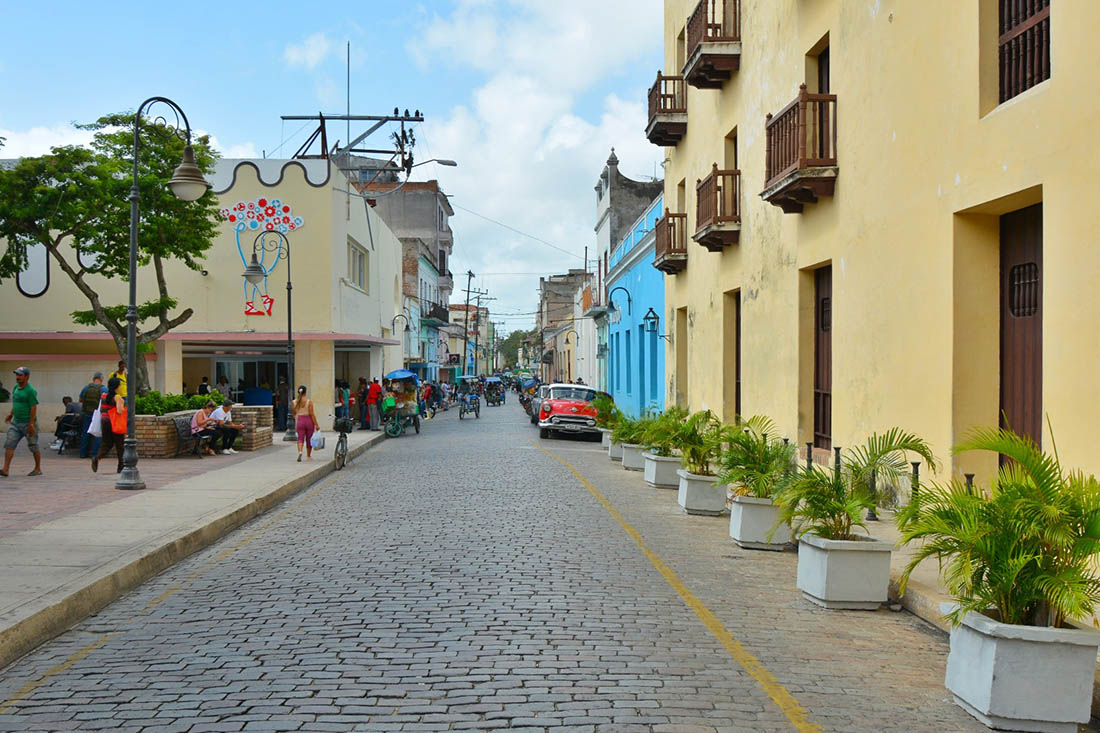
Independencia Street is a first category axis made up of seven sections with a length of seven hundred and fifty meters long. Paved entirely with cobblestones, it presents two behaviors with respect to land use. One from Ignacio Agramonte where it begins, to Luaces, and from Luaces to La Plazuela del Puente. Where in the first one is mostly the use of land dedicated to the Cultural, Gastronomic, Commercial, Services and Administrative sectors and in the second it is more centralized in the use of residential land.
The street is one of the urban axes that make up the so-called golden triangle, which is formed by Maceo and Ignacio Agramonte streets and Independencia itself. Creating that triangle in the urban fabric that is supported by squares and churches in each of its three vertices, these being Gallo, Workers’ and Maceo squares. These squares have already been intervened along with the properties that surround them and have been converted into places of rest and recreation, just like the streets that join them, converted into pedestrian walkways or boulevards such as Maceo Street and thematic streets such as Independencia Street, dedicated entirely to the seventh art.
Only the intervention of Independencia Street remains, which presents major problems such as the existence of architectural barriers, parking on the road, and the loading and unloading of merchandise during peak hours. All this in inequality with the strong pedestrian flow, greater centrality and an axis with properties of protection grade I and II.
Rehabilitation Proposal for Independencia Street. Cultural Walk
For this, the main intervention tasks will be in the first two sections of the streets, ranging from the intersection with Ignacio Agramonte Street to Maceo Square, including the current Las Cubanitas cafeteria and the park adjacent to Coppelia.
This will bring visible changes in the street and in urban spaces such as Las Cubanitas park, which will range from the treatment of the floor, bringing the entire street and urban spaces to the same level, the incorporation of urban furniture such as litter bins and lights, as well as of the construction of a new punch in the pavement for the green area with its planter benches in the Coppelia park. To all this, it is added that the street will also have projects for changes of use in several of the properties that make it up.
Las Cubanitas Park
For this space, it is intended to develop the floor design that has been worked on throughout the journey, expanding it in turn towards the interior of the cafeteria of the same name. The number of benches will be increased, as well as the shadow areas closely linked to them by creating an intermediate bench between the two existing ones. These benches that exist today will be redesigned with granite backs and tops to achieve a better integration with the interior of the cafeteria.
Las Cubanitas Cafeteria
The space currently occupied by Las Cubanitas Cafeteria will undergo visible changes not only in its spatiality, but the place will be entirely dedicated to ballet. Being very easy to achieve this concept because adjacent to it we find the emblematic Coppelia ice cream parlor which bears its name thanks to the ballet of the same name. Through this discourse, the space of Las Cubanitas will be covered with the theme of ballet, even leaving a space dedicated to Camagüey’s ballet and its most outstanding figures.
Changes of use
On the occasion of the revival that is intended to be given to the street, certain buildings are proposed to change their current use for one more in line with the concept that is to be achieved. These buildings will have specific projects each. Among the changes of use will be the property that occupies the point of sale of the dairy, transforming it into a cafeteria with exteriorization to the street and the property adjacent to it that is used as a bakery which will maintain its use, also offering the confectionery service, also including exteriorization to the street.
In the second section of the street we will find another of the changes of use that the project will bring about. The current headquarters of the Mixed Retail Commerce Company will be transformed into a Jazz Bar-Cafe-Restaurant which will also be externalized to the street.
The street
It is intended to level the cobblestone street at the same height as the sidewalks, creating a single platform, this will have ramps at the entrances that will bridge the difference with the streets that intersect the sections in question. At the same time, a central strip of cobblestones will be left for the entrance of vehicles in case of emergency and the service entrance to the Coppelia building, which must be daily.
The rest of the section will be made up of adocrete slabs and concrete panels, in addition to the creation of two waterways, one on each side of the cobblestone, for the evacuation of rainwater, which are present in the final design of the street.
The Project will not only have visible changes in Independencia Street, but also changes that will make the space and the city win in several factors, such as the safety of people on the road, taking into account the characteristics of the road section and the competition with the automotive movement and high level of population aging. The protection of built heritage by reducing vibration levels in areas with a concentration of protection grade I and II buildings.
In quality of life by reducing environmental pollution. With pedestrianization pollution is avoided, not only atmospheric, but also acoustic; the noise where people move freely and without pressure and stress is not the same as that of a street with the deafening noise of vehicles.
The insertion of green areas and street furniture attenuate the effects of solar radiation, improve environmental quality and turn these streets into recreation and exchange areas for the city. It turns the area into a point of attraction, economic activation and excellent services. New sources of employment are generated, commercial dynamism is gained and the value of the Historic Urban Landscape is enhanced.
Translated by: Aileen Álvarez García