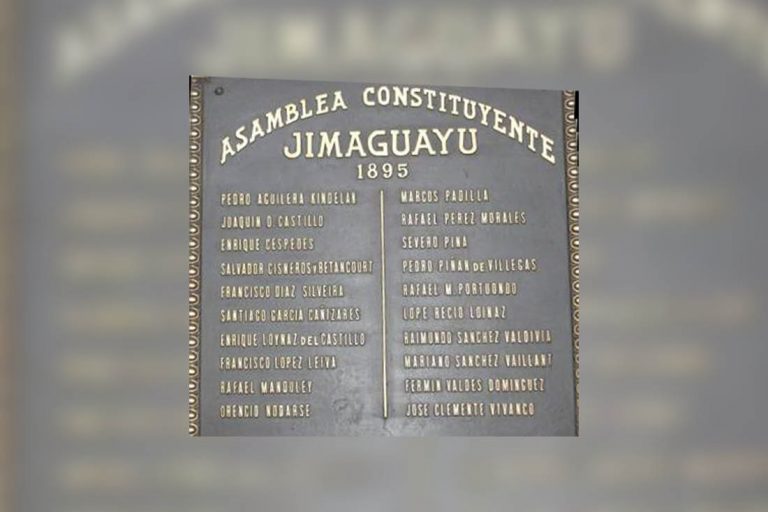
Signed on September 16th, 1895 in the fields of Jimaguayú, as a tribute to the patriot Ignacio Agramonte, this constitution established the Government Council as the supreme authority of the Republic, with legislative and executive functions. It endorsed the democratic essence and demonstrated the maturity of the emancipatory struggle of 1895-1898.
The fields of Jimaguayú are sacred, they have been since 1873 when the distinguished patriot Ignacio Agramonte Loynaz fell in combat. Martí, among his few belongings in exile, owned land from Jimaguayú. Later, Máximo Gómez chose this historical site for the celebration of the first Constituent Assembly of the emancipatory contest of 1995, to pay homage to one of the founding fathers of the nation.
The Constitution of Jimaguayú has its antecedents in the conformation of a constitutionalist thought on the Island, especially the constitutions of the Republic in Arms of Guáimaro and Baraguá; the latter hardly known.
The work of preparation for the war led by José Martí, with the maxim of a “Republic with everyone and for the good of all”, announced for the future a Magna Carta that would overcome the discrepancies that had arisen in Guáimaro, related to the division of military and civil powers.
In this way, in the Montecristi Manifesto, “Cuba returns to war with a democratic and cultured people…” was expressed, an essential aspect of the future Assembly that took place in Jimaguayú between September 13th and 16th, 1895. In it The Council of Government was instituted as the supreme authority of the Republic, with legislative and executive functions and a concept of State.
On the other hand, the brief text with 24 articles and the participation of twenty assembly members representing all the army corps, recognizes the Island for the first time with the name of the Republic of Cuba; it also assumed the validity of the text for two years. Superior aspects to the Constitution of Guáimaro.
The document endorsed the democratic essence and established an organizational scheme that the jurist and researcher Ph. Carlos Manuel Villabella Armengol, considers that it was “[…] a clever solution […] of military autonomy […] but based on legal and republican forms.”.
And so, to the pride of the people of Camagüey, once again Salvador Cisneros Betancourt, an outstanding patriot from Puerto Principe, would occupy the Presidency of the Republic; while the positions of General in Chief and Lieutenant of the Liberation Army would be assigned to Máximo Gómez and Antonio Maceo, respectively. The ruling magna carta of the democratic principles of the conflict marked its maturity.
A singular event related to the Constitution of Jimaguayú that few Cubans know is the fact that until 2015 it was believed that the only copy that existed was in the National Archives of Cuba, it has an ink stain when the inkwell was spilled during the signature of the participants.
However, specialists from the Oscar María de Rojas Museum (Cárdenas, Matanzas province), revealed the presence of another original copy, which in 1943 had been recognized and disclosed by the newspaper El Mundo, although it later passed into oblivion misplaced among the numerous documents that the institution owns.
The news of its discovery was endorsed by the authentication and donation certificate made by Colonel Francisco López Leiva, participant in the event as Chief of Staff of the Second Division of the Fourth Corps of the Liberation Army, and representative of the same in the Assembly of Jimaguayú as Secretary of the Board. Oscar María de Rojas himself acknowledges receipt of such an important document.
The Jimaguayú Constitution, due to its importance as a legal document that gave the country a concept of State, has been registered in the National Registry of the UNESCO Memory of the World Program since 2015.
Translated by: Aileen Álvarez García