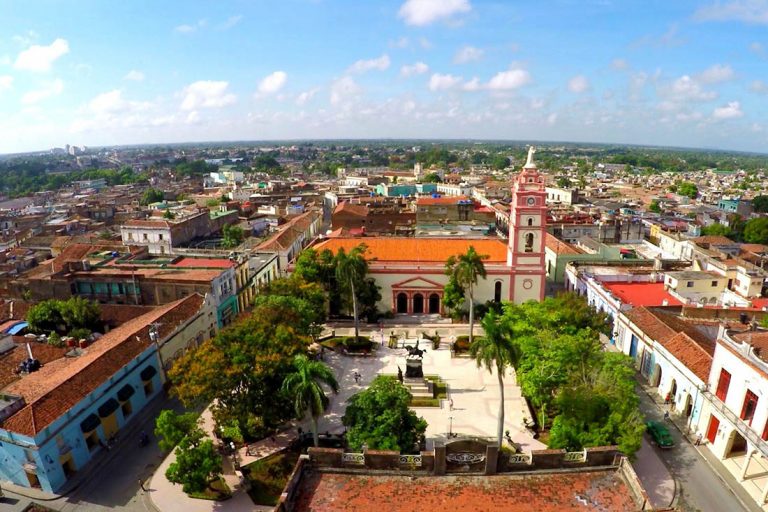
The declarations as National Monuments of the Historic Center of Camagüey city, Las Clavellinas Historic Site, the Birthplace of Ignacio Agramonte and the San Juan de Dios square and hospital, are the result of important actions carried out for the sake of Camagüey’s cultural heritage conservation.
Precisely the first interventions aimed at its rescue and conservation began, as the architect and doctor in Technical Sciences, Oscar Prieto Herrera, rightly declares, at the beginning of the seventies of the last century; with very concrete but necessary actions, linked to the main exponents of Camagüey’s monumental heritage. These efforts were aimed at the intervention of the facades of the buildings that make up the San Juan de Dios square, the rehabilitation of the Main Theater and the Birthplace of Major General Ignacio Agramonte, in commemoration of the centenary of his fall in combat.
The status of National Monument
Precisely because of the exceptional nature of some of these buildings and their importance as historical-cultural places, on October 10th, 1978, according to Resolution No. 3 of the National Monuments Commission, thanks to the proposals submitted to said commission by the provincial commissions, it was decided to declare as National Monuments, among other urban historical centers, sites and constructions of the country, the Historic Center of Camagüey, the San Juan de Dios square and hospital, the Birthplace of El Mayor and Las Clavellinas Historic Site.
Urban Historic Center of Camagüey city
Now, although the official declaration of the Historic Center of Camagüey city as a National Monument was granted on October 10th, 1978, it was not until November 10, 1980 that the National Assembly of People’s Power made such a distinction official, which is published in the Official Gazette of the Republic.
Lourdes Gómez Consuegra explains that the initial investigation for said declaration was a request from the Government of the province to the University of Camagüey. Initially, a general inventory was carried out that covered the entire area, because it was essential for that purpose and there was no such instrument.
Other actions carried out
Also, with a view to declaring the historic center a National Monument, other efforts were made, such as the conditioning of the stairs of the side doors of the Church of La Merced, located in Workers’ Square.
Historical places
In the case of the San Juan de Dios square and hospital, and the Birthplace of El Mayor, they are places that not only stand out for their architecture, but also for their relevant historical value; for both local and national history. In this same condition is Las Clavellinas historic site, whose importance is evidenced in the obelisk that commemorates the Uprising of November 4th, 1868.
Final considerations
The declarations of National Monuments in the province of Camagüey allow us to appreciate even more its patrimonial and cultural richness, in a context where memory and identity play a fundamental role.
Bibliography
Gómez Consuegra, Lourdes. “El Centro Histórico Urbano de Camagüey, Patrimonio Mundial. Planeamiento, gestión y manejo”. Apuntes 22 (2), (julio-diciembre 2009), 142-155.
Prieto Herrera, Oscar. “Acciones de conservación en el Centro Histórico de Camagüey”. Arquitectura y Urbanismo, XXVIII (1), (2007), 36-40.
Resolución No.3. de la Comisión Nacional de Monumentos, Ciudad de La Habana, 10 de octubre de 1978, “AÑO DEL XI FESTIVAL”.
Translatedby: Aileen Álvarez García