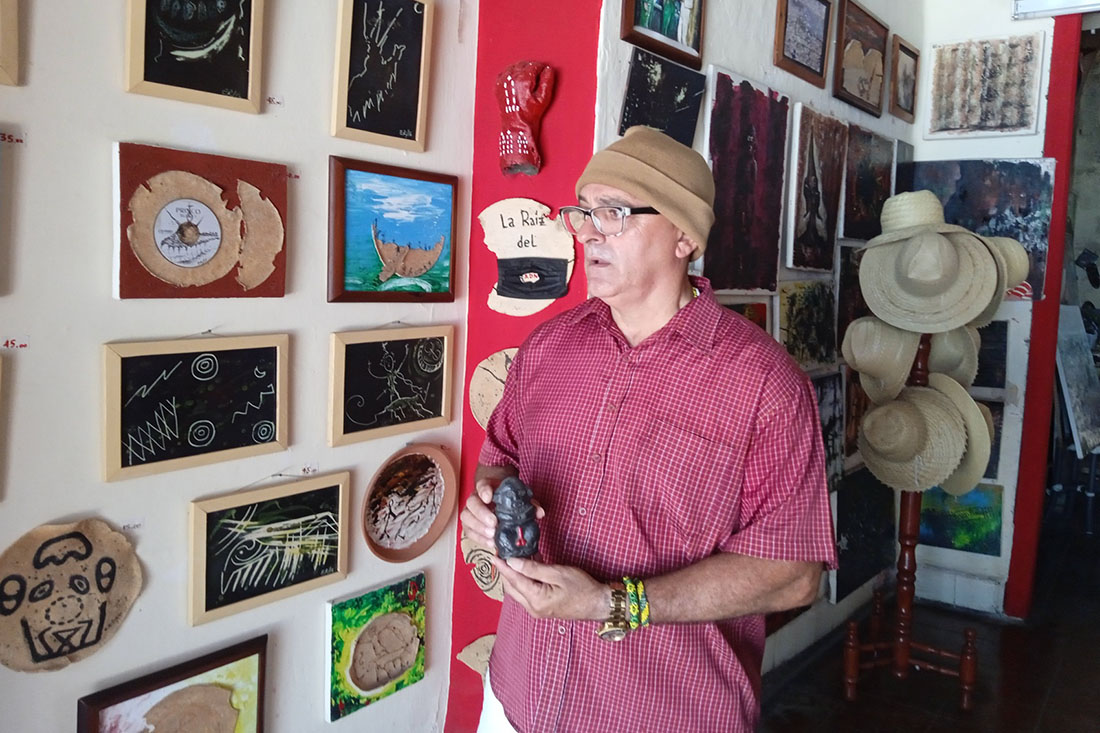
If we look into the corridor of the study gallery of the Camagüey plastic artist Eduardo Rosales, we can approach, through his works, to our origins, customs, deities and rock art.
Hand in hand with the host, we begin a journey of more than 500 years, to go back to pre-Columbian times and remember that before the conquest, the Taínos inhabited these lands and had their own culture.
For this reason, although the themes that he reflects with his brushes are divided into “aboriginal”, “African” and “modern city”, we can say that Rosales’ work dedicates a large part to elements that, because they are essential, we sometimes forget: those of the beginning of civilization.
A journey through aboriginal life
In essence, some of the motifs of the pictographs of the caves of Camagüey, the artist recreates them in different supports. That is why we can find such diverse materials: yaguas, fibers, jute bags, tobacco leaves; and the most creative of his paintings, on casabe cakes.
A parenthesis
Since the development of civilization on the island, the aborigines, seeing the need to store their food, began to grate the cassava and bake it in the burén. This is how that delicious food arose, which has survived to this day and accompanies our diet in many ways.
In our territory, in the town of Vilató (Sierra de Cubitas municipality) 10 casabera families settled. Its tradition of more than a century producing cakes has as background the creations of the grandparents, who made it in the way of the natives of that area; and despite the complexity and laboriousness of its preparation, today’s producing families ensure that they keep alive the delicious aboriginal heritage, which transports us to the past when we taste it.
We continue the journey
Rosales tells the Taíno story; he recontextualizes it in natural supports. His works from the Pichardo cave, María Teresa and many others come to us thanks to his brushes. The equestrian warrior that La Avellaneda recreates in his work Sab is here in different materials, to remind us along with the stars that life is cyclical, that it repeats itself over and over again, and that if we forget our history we are doomed to repeat it again.
We continue talking, and almost passing to the African area, the artist points out something notorious: The black slaves they brought to Cuba learned the use of plants and marooning with the aborigines. It was they who showed them how to hide in a cave to flee from the Spanish, and how to make poultices from different herbs to heal wounds.
A necessary interruption
Rosales is an excellent conversationalist, an authentic Camagüeyan who enjoys sharing his knowledge. For this reason, his gallery -near San Juan de Dios Square- is not only included in the routes of the Arte Plaza creative industries project, but is also frequented by students of various artistic specialties.
While he offers me information for this chronicle, we are interrupted by neighbors, visitors, vendors and three girls from the Vicentina de la Torre Academy of Arts, interested in learning about techniques and textures. In addition, they enjoyed a class on Freemasonry, African religions, ancestral customs and heritage values of our beautiful city.
Mary, who was a student of the artist when she was little, now studies painting and brings her colleagues to visit places on the creative circuit; but an obligatory stop is at Rosales’s studio, from where beautiful ideas are born, which highlight our mestizo identity.
We continue the journey
Its landscapes with African flora and fauna pay homage to the slaves, who left their blood and their dreams on this land, mixed with our libertarian causes and treated them as their own.
To pay tribute to their brothers of Yoruba faith, they occupy the central part of the gallery and show the importance of doing good, of helping and not lying, according to the laws of Ifá.
The third part of the room deals with the most contemporary, where Rosales highlights the colonial city with night landscapes of his beloved Camagüey.
A small table located in a corner arouses my curiosity. As I approach, the artist smiles modestly and whispers to me: “These are my new creations, with coffee. What do you think?”
“I find them very original, since they simulate sepia portraits of the old and beautiful mansions, squares and places of the city, such as the railway, the San Juan de Dios square itself and other corners of the historic center,” I answer.
Later, I learned from other sources of information that when foreign visitors arrive at the workshop, they enjoy making their own works with that innovative technique, which takes advantage of the “leftovers” of the café made at home to create images.
A popular curiosity
I could not imagine that a totem with an aboriginal fertility deity, El Yaya, would be so sought after by women. Rosales mischievously comments that single women, married women or widows come in search of the petrified Yaya with the racú technique, to achieve the miracle.
We return to the entrance
To close the cycle of energy that this visit has given me, I want to tell you about the installation that welcomes you. It is a work that refers to the diversity of cultures that contributed to ours.
Sitting next to the host of the studio gallery, in the doorway, I could appreciate how two hands -one white and one black- point to the root of our Taíno DNA; which is adding Spanish, African, Chinese and even Russian. According to Rosales’ criteria, everyone who left a descendant on the Island contributed to the wonderful union that we now call identity.
Thus ends the journey of more than 500 years of civilization in the Greater Antilles and the pleasant meeting with the ancestors. Thanks to the brushes and colors of Eduardo Rosales for hosting this past look, an essential part of who we are today.
Translated by: Aileen Álvarez García