The uprising of Las Clavellinas marked the beginning of the militarily organized entry of Camagüey into the Ten Years’ War of Independence, an action that constituted a transcendental bastion for the conflict.
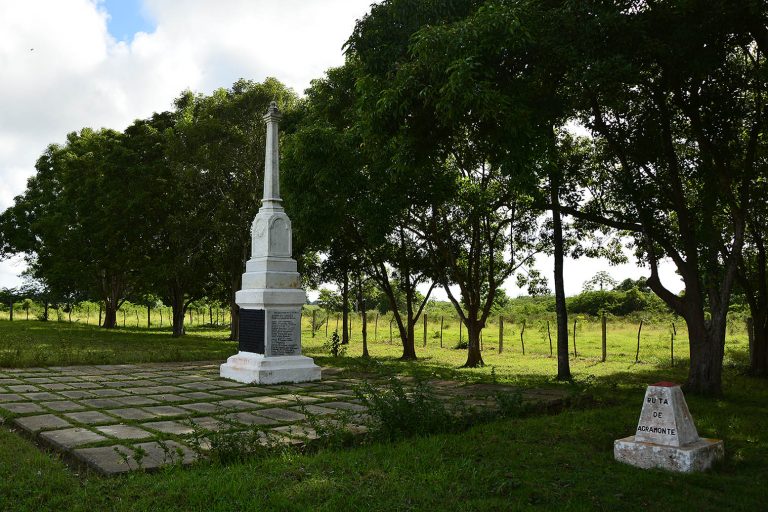
Camagüey province has several monuments dedicated to significant events of the Ten Years’ War. Among them, the one located in Las Clavellinas stands out, where a group of 76 patriots met at dawn on November 4th, 1868, marking the organized entry of Camagüey into the armed struggle.
How did the event unfold and how much impact did it have on the country’s history? These are questions that may seem rhetorical, but their answers require a careful look at one of the transcendental moments in the formation of the Cuban nation.
Sometimes, the historiography of the Great War shows some stigmas about the late incorporation of Camagüeyans to the war. However, an approach to the facts allows us to assess in greater depth references that seem isolated, but that are overtones of the Cuban independence process itself in the region.
The incorporation of Fernando Agüero Betancourt and other patriots, in the month of October, attacked and dissolved by the Spanish authorities -which later regrouped and operated between the south of the current Vertientes and the west of Santa Cruz- is a first indication.
Later, Manuel Arteaga -a friend of Agüero Betancourt- supported his action and joined with a troop of 46 men. Bernabé Montejo, with another group, operates in the vicinity of Santa Cruz; while Lope Recio Borrero does it for Las Pulgas farm, and Pedro Recio Agramonte maneuvers in La Quemada, where he had his properties.
Special attention requires the uprising of the brothers Agusto and Napoleón Arango Agüeros. The first takes the towns of Sibanicú and Cascorro on October 30th; while Napoleon, for his part, occupied Guáimaro on November 4th. In that place, he takes prisoner the Civil Guard forces that were there.
These actions show that in the territory of Camagüey there was support for the independence cause almost immediately; although, as in other regions of Cuba, the criteria on the beginning of the conflict were not homogeneous among the conspirators.
Reasons were not lacking for those involved: some alleged the risk of being discovered; and others, the need to guarantee greater logistical and economic resources. The fight for the independence of Cuba forces us to perceive the nuances that every act of this type implies.
It cannot be ignored that months before, the Revolutionary Board of Camagüey -headed by Salvador Cisneros in talks with the easterners- had specified that it was essential to ensure the necessary conditions for the armed uprising.
The situation in the town since October 10th was almost untenable. Lieutenant Governor Julián Mena evacuated the Convent of La Merced to collect food and other supplies, reinforced surveillance, erected barricades throughout the city and proclaimed an exceptional state to intimidate sympathizers, collaborators and committed patriots.
Immediately, Manuel de Jesús Valdés Urra “Chicho” left for the Guaicanamar area, between Puerto Principe and Santa Cruz del Sur; he is accompanied by Bernabé Varona (Bembeta).
Later, the organization of the Spanish offensive from the city and the sending of reinforcements -information offered by José Ramón Betancourt on weapons and ammunition that would arrive from Havana to Nuevitas- led to changes in plans among the Camagüey patriots.
The decision is not expected. Salvador Cisneros had already responded to José Ramón: “don’t worry, they won’t come.” Along with Eduardo Agramonte, he summons three patriots to the Philharmonic Society for that same night. There, to support the movement, they decide to meet at the Saramaguacán river pass or Las Clavellinas on the way to Nuevitas.
At the selected site, the group of 76 men – among whom were neither Cisneros nor Ignacio Agramonte, dedicated to other revolutionary tasks and incorporated on the 5th and 11th, respectively – went to the “El Cercado” sugar mill.
Eduardo Agramonte Piña organizes the troops militarily. Jerónimo Boza Agramonte was chosen superior chief, and Gregorio Boza, second chief. The command of the seven platoons was in charge of Ignacio Mora de la Pera, Manuel Boza Agramonte, Martín Loynaz Miranda, José RecioBetancourt, Eduardo Agramonte Piña, Francisco Arteaga Piña and Manuel Agramonte Porro.
Once again the Betancourts, Agramontes and Agüeros, among other Camagüeyans, make emancipatory ideas their own. Camagüey on the warpath, between the cheers of “Long live Free Cuba ” and “Long live Carlos Manuel de Céspedes”, constituted a transcendental bastion for the liberating struggle.
Translated by: Aileen Álvarez García