Camagüey city is closely linked to the history of postal mail in Cuba. Various facts, as unique as they are curious, have been the subject of study for philatelics inside and outside the Island.
“When we talk about philately we are not only talking about postage stamps, but about everything related to mail. Precisely, during the War of 1968 it was necessary to create a postal system and Céspedes gave Vicente Mora de la Pera, a Freemason from Camagüey, the task of creating a postal system for the mambises, what we know today as the Mambí Post Office. From then on, stamps with values are created to endorse them on the cover of letters that were destined for Cuban emigration. It was possible to create a system of relays on horseback and by boat that would ensure the transit from Oriente to Camagüey and from here to Jamaica and New York.” The journalist and researcher Oreidis Pimentel Pérez, creator of the blog Filatelia desde Cuba, explains.
In 1895, during the Necessary War, Gonzalo de Quesada reprinted the stamps to resume the Mambí mail, which became faster and more efficient than the Spanish one.

A few years later, during the North American intervention in Cuba, the history of philately in the largest of the Antilles once again has important references in events that occurred in Camagüey
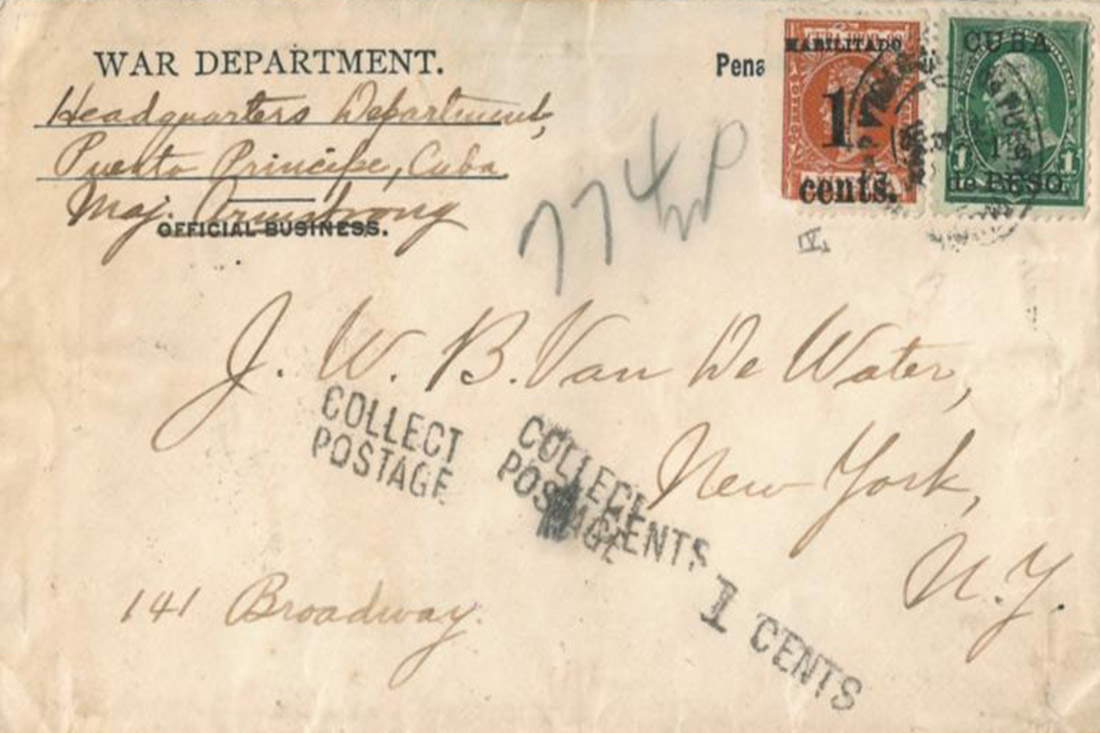
“Camagüey has the privilege of being the first Cuban territory with its own stamps, it happened during the North American intervention on the Island at the end of the 19th century. Louis Carpenter, the military comptroller who occupied Puerto Príncipe, determines that a communication system is necessary for his troops. For this, he only had large sheets of legalized stamps that Spain had left, so he ordered an overprint and an authorization, which is nothing more than printing a new value with black ink on the stamp itself, in this case North American values of one, two , three and five cents. They are the ones that are known within philatelics as the authorized ones of Puerto Príncipe”, adds Pimentel Perez.
These stamps circulated from the end of 1898 to the beginning of 1899, when stamps with values in the circulating currency were enabled for the whole country.
During the Neocolonial stage, overloads of postage stamps also occurred in the province. Firstly, in 1917 with the liberal uprising and the one known as the little Chambelona war, then in the 40s when an overload was carried out in honor of Cardinal Artegana from Camagüey, invested as the first Cuban cardinal. In both cases most of the stamps were collected and destroyed, although there were always collectors who managed to keep some.
“Some forgeries were later made of the Chambelona stamps, evidently someone preserved part of the material with which they were made. It is very difficult to know when it is an original or a forgery, for this you have to carry out a study of the ink from the overload and an analysis of the position of the letters, which have millimeter differences”, comments Oreidis.

Other events of stamp overloads were recorded in the 1930s at the Jaronú sugar mill and after the revolutionary triumph in 1959.
The truth is that Camagüey is a wide source of curiosities for those passionate about philately, a territory of numerous stories linked to postal mail in Cuba.
Translated by: Aileen Álvarez García