The architect from Camagüey Francisco Felipe Herrero Morató (Barcelona, 1893 – Camagüey, 1954) had in his professional life important works that came to enrich, each one in its time, the building panorama of Camagüey city (La Caridad Market, Colón Hotel and the neocolonial remodeling of the Liceo, today the Provincial Library, among others).
But it was on the subject of theater in which this prolific author demonstrated greater knowledge of the technique and absolute skill to undertake large-scale projects.
Herrero Morató carried out the major reconstruction of the Main Theater after the fire in the twenties, adding an eclectic portico that remained standing until its remodeling in 1977. He had already ventured into the subject of theater in 1926 when he produced the version we know today of the Avellaneda Theater for Alberto Mola Marín, famous film businessman from Camagüey.
However, it was not until 1948 when, for the same owner, he conceived, projected and executed his best work, the Alkázar cinema theater on Liberty Avenue.
Graduated as an architect and civil engineer from the University of Havana in 1917, Herrero Morató was mayor of Camagüey between 1925 and 1926, and Minister of Public Works between 1941 and 1943. The chronicles of the time and the testimony of acquaintances agree that this man enjoyed the sympathy of the great public in Camagüey and the most prestigious intellectual circles, perhaps for carrying out his civic responsibilities and his successful professional career with equal zeal.
The architectural ensemble
With more than 3,000 square meters of surface area, the Alkázar Theater, the most refined work of Francisco Herrero Morató, is an unusual architectural ensemble in the city and has remained since 1951, with its maximum capacity for 1,500 spectators, the largest and most luxurious cinema from the interior of the country.
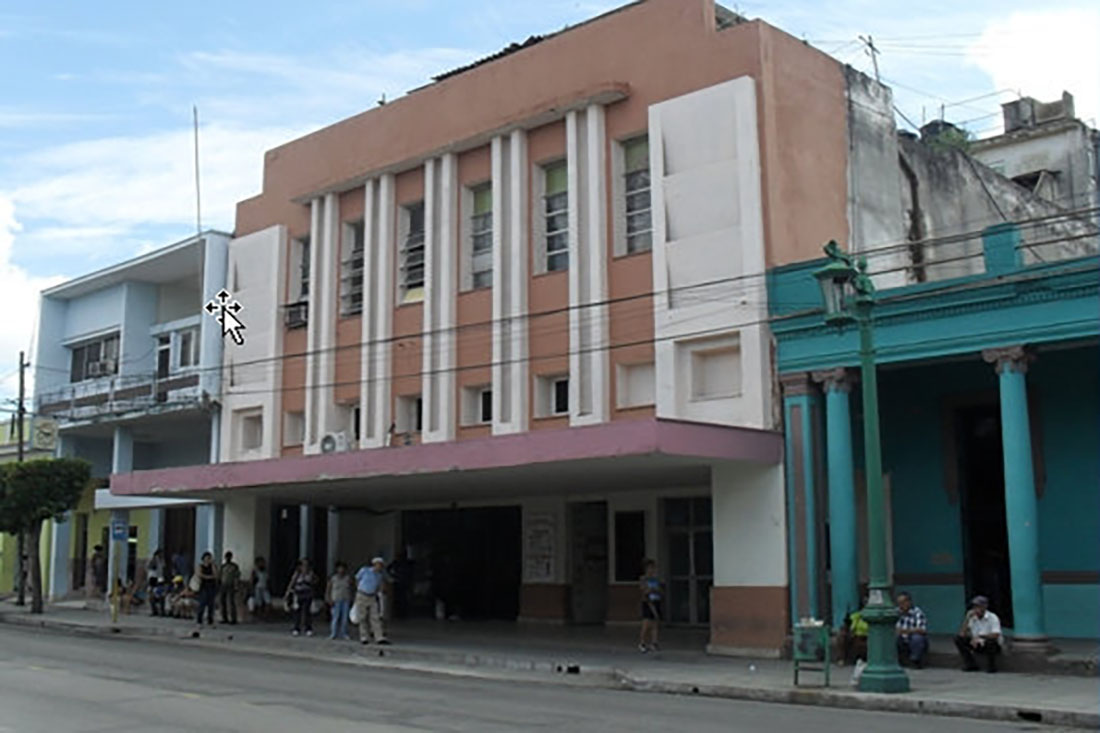
The facade of the Alkázar Theater is a classic example of the transition from 20th century architecture to Modernity, of the conflict and confluence between verticality and horizontality, without any of the two criteria taking precedence. The inclined elements, on both sides of the façade, contain the stage lighting, which together with the vertical pilasters confirm the presence of Art Deco, so dear to buildings for cinematographers.
It could have been better inserted into the architectural fabric, if it weren’t for the concrete canopy, which defiantly flies over the road without taking into account the height of the portals on the avenue.
In its vast interiors, classic formal and comfort elements of the repertoire, style and period are exhibited. Curved stairs and surfaces, large vertical glass windows, luxury toilets and toilets in the basements (in a city without basements), a foyer on each level and smoking rooms on the upper balconies, the ticket office in a spacious lobby interior, and a huge projection room with a lower stall and “balcony”.
The other novelty for Camagüey is the conjunction, within the same building, of several apparently incompatible functions. The main function is the cinematograph, with a luxury cafeteria on the ground floor that opens to the outside, where an 8-meter-long gigantography, exceptional for the time, reproduced a color frame from the American film “Seven Brides for Seven Brothers.” ”, of “recent” premiere.
On the mezzanine, above the cafeteria and the lobby, a Night Club, and above it, 2 private housing apartments overlooking the avenue. The back of the theater is continued, up to the parallel street, with another three-story multi-family building, also owned by Alberto Mola.
Until the moment of its last intervention, it kept the original furniture of the halls and the glassware of the façade, the entire factory window, executed in discreet Art Deco forms, as well as the acoustic decorations of the projection room and an excellent recirculation system of air conditioning whose extraction mouths were located on the floor of the stalls, between the seats.
The second half of the 20th century saw outstanding national and international figures from the artistic world in vogue parade through its stage and delirious theatrical shows like the city does not remember, at the same time that it was the scene of important political and civic events in the city and the nation.
On May 29th, 2015 -coinciding with the date of May 29th, 1947 on which the project was requested from Herrero Morató- and given the advanced deterioration of its interior spaces and their lack of use, the local authorities requested and decided undertake a remodeling and change of use project that, in keeping with the broad values of the property, explicit in the granting of the “Degree of Protection I” that the building holds, would be able to restore the complex to its original splendor and save it from neglect and the abandonment of decades.
The authors of this remodeling, the architects Wilfredo Rodríguez Ramos and Alexander Ramírez Matos, were in charge of solving a complex problem: converting the lower stalls of the projection room into a theater café with a bar, light meals and varied shows around the magnificent original setting and maintaining the cinema function in the Balcony, without for these reasons compromising the integrity of the architectural ensemble and its proven stylistic values.
Based on the concept of contemporary reinterpretation of the luxurious Art Deco style, the project complied with the established regulations and program, intervening in each and every one of the public and technological spaces of the theater, which in this way was able to revive the magnificence of its interiors and the elegance of its façade, to which a replica of the original light sign, lost since the 1960s, was returned.
The new Alkázar Theater was opened to the public in 2017 in a lucid act, honored with the presence of Mr. Eusebio Leal Spengler and Miguel Díaz-Canel Bermúdez, President of the Republic of Cuba.
Translated by: Aileen Álvarez García