When Gabriel García Márquez wrote “The Interview”, he forgot to classify a type of questionnaire: that which is not based on written or oral words, but on gestures, looks, emotions. That is why talking with Isa was a challenge from the first moment, as she put to the test my skills as an interviewer by making me understand in the most practical way possible that communication is more complex than a series of questions and answers.
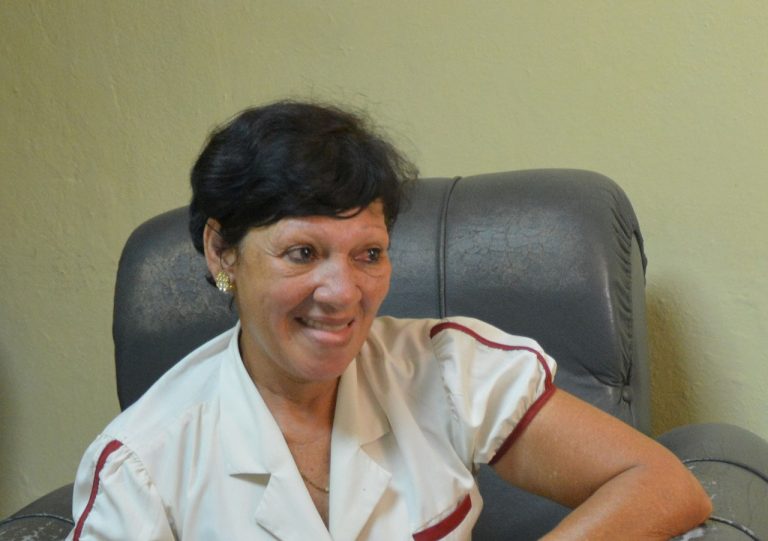
Isabel Cisneros has been working in the Revolution Square for 20 years as a receptionist, but she likes to do a little bit of everything: “I serve coffee, attend visitors, clean, organize, here we all work with a common goal.”
Her nervous hands cannot stop touching the chair and her cheeks turn red at each question. “Isa, tell him about your results here in the Revolution Square”, I hear some voices from behind me. But she only tells me “commitment” and her eyes light up with passion, sensitivity and love. That word was enough for me to understand that Isa is an extremely humble and sweet woman, who has dedicated her life to her work. “The Guillén Hall is my jewel”, she manages to tell me. “Sometimes it is clean, but I insist on continuing to organize it, because I like to see it impeccable.”
“Isa, tell her about the personalities you have met”, they keep talking to her from behind and she looks at me, lowers her head and almost muttering, mentions them: “Here I met Raúl, Vilma, Almeida, Rosita Fornés and many other important figures. I keep those memories with great affection”.
Isabel’s name appears in the Book of Honor of Camagüey’s Women, because in the act of fulfilling your duty, and fulfilling it well, the fact of not living “just for living”, as Martí would say, is the language that Isa best understands, more than the insistent questions of an interviewer.
“Now I feel very sad because the Revolution Square is empty, because no one comes and she is like a mother without her children; That is why I feel empty too, because what I like the most is seeing movement in this square, seeing a smile on people’s faces and knowing that my work played a small part in that happiness. ”
But for her, to belong to a place is to love it beyond any limits: wages, circumstances, personal situations. That is why she take refuge in the Revolution Square as that space that encouraged her and where she feels useful.
Isa likes to read the newspaper and keep her uniform always clean. She also enjoys watching baseball very much: “this year the Bulls will win,” she told me with the confidence of a true Camagüey’s resident. People say that she has an enviable memory and that she updates everyone early with the day’s anniversaries.
“Sometimes due to the hustle and bustle of work, one does not remember certain events and commemorations, but whenever we arrive, Isa is there to remind us, because for her every page of history is important,” the Director of the Revolution Square tells me.
“Journalist, did we finally finished? ” I realized how uncomfortable she feels talking about herself. She does not know the value that she keeps in her humble look as an anonymous heroine. But I did not want to prolong her tears and I gave up on this gestural interview, full of symbols and memories, which could never be put into words. Not even for García Márquez. So I put away the pen, the notebook, the cell phone and we continued talking about baseball.
Translated by: Aileen Álvarez García