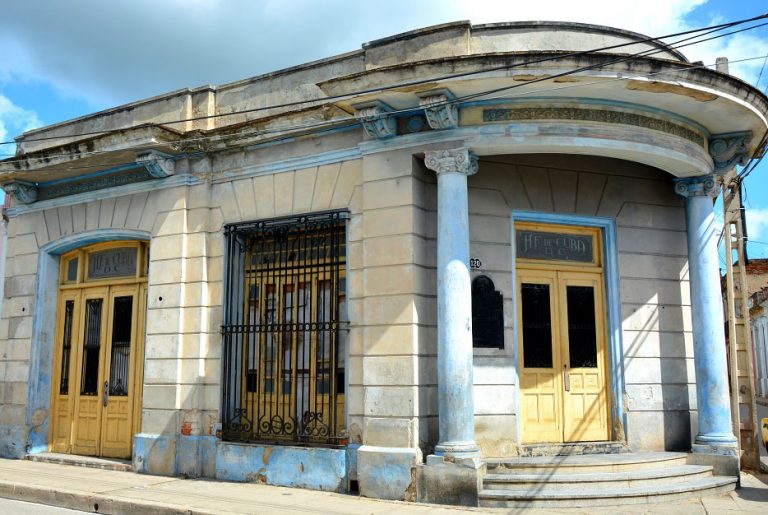
On the corner formed by the streets Santa Rosa and Francisquito, popularly known by the people of Camagüey, nowadays Florentino Romero and Dr. José Rodríguez # 120, is the property that in its interior housed since 1932 one of the largest unions in the railway sector in the country: “The Cuban Railway Brotherhood”. Due to its importance in the history of Camagüey, today we turn our attention to that brotherhood.
On July 6th, 1920, “The Railway Brotherhood” was founded on Santa Rosa Street # 30, in a colonial house from the second half of the 19th century, made of wood and wide-fronted tiles. Nowadays, it is made of masonry and it preserves its roof very similar to the one it had in the twenties of the last century. Its first president was Andrés Otero Bosch.
After its foundation, the machinists, stokers and telegraphers who worked in the The Cuba Railroad Company joined the brotherhood, reaching in its beginnings more than 350 members. This was an organization through which their interests were represented before the company, through their designated delegates. There the affiliates fraternized in a harmonious environment and carried out their social activities.
With the passage of time and the importance that the Railway Brotherhood was taking within the railway workers for the defense of their rights, on February 2nd, 1924 a new brotherhood was created, now with a national character, called “The Cuban Railway Brotherhood”.
In Camagüey the Central Directorate would fall, headed by Andrés Otero Bosch, former president of the Camagüey brotherhood, accompanied by Juan Arévalo, as vice president, who would be in front of delegation number 2 from Havana and Manuel Castellanos, as Legal Advisor. Among its objectives was to achieve the greatest harmony and interpenetration of ideals among the railroad workers, strengthening their relations of cordiality and Pan-Americanism with other workers’ activities, taking part, through the delegates, in the decisions of The Cuban Railroad Company and that with this cooperation improvements will be achieved for the proletariat.
It was proposed to unite all the personnel belonging to the various public and private railway companies existing in Cuba and those that could be established in the future, pursuing the material and moral improvement of its associates, influencing this in the living conditions of all railway workers without distinction of company.
The delegations in Santa Clara, Sagua la Grande, Caibarién, Cruses, Cienfuegos, Matanzas, Cárdenas, Puerto Padre, and the two existing companies in Guantánamo and Santiago de Cuba, rapidly multiplied until there were fourteen delegations in the country. Only two groups of workers remained on the sidelines: the Camagüey Workshops Union and the North of Cuba Railroad Union.
In 1930 the “The Cuban Railway Brotherhood” bought a larger property for its headquarters on the same street corner Francisquito # 25, due to the importance and prominence that the organization had gained within the railway sector throughout the country.
For this, a two-story building was projected, as shown in the plans that are in the background of the City Hall of the Provincial Historical Archive of Camagüey. The second level was never built due to the lack of funds, remember that it depended on the contributions of its members and in those years Cuba was going through a major economic crisis, as a result of the Great Depression in which the United States of America were involved since 1929.
Even so, it was possible to build a building that until today stands out in the corner where it is located. It consists of a large room, which was either used for the meetings of its members and social activities or as a game room, also for its members. It is also composed of three offices, in one of which they located the library acquired by the Brotherhood to spread culture among its associates. A printing press was installed in which the weekly “Heraldo Ferroviario”, the official body of the community, was printed; in this weekly the events of the internal life of the Ferroviaria de Cuba Brotherhood and its work were collected. It is worth noting that there was located the delegation # 1 of Camagüey and the Central Directorate of the Brotherhood.
The Railway Brotherhood, as the building is known, is a witness of the years of struggle for the rights of railway workers from its foundation until the triumph of the Cuban Revolution. Ignoring the directives of the bosses’ leaders, they supported the struggles of the entire Cuban people and their oppressed working class, such is the case when they launched in support of the general strike of August 8th, 1933 against the fierce dictatorship of Gerardo Machado, a man who so many times had trampled and repressed the different rail unions in the province.
The members of the Railway Brotherhood accompanied the general strike of March 12th, 1935 in union with the Office Employees Union and the Union of Workshops against the provisional puppet government of Colonel Carlos Mendieta and the strongman for the North American government in Cuba, Fulgencio Batista. The list of their struggles would be too long to be included in this little work.
The years 1959 and 1960 were essential in the Cuban Railway Brotherhood, first, because it knew how to put itself in the right place, next to the nascent Revolution, removing all the puppet bosses and putting it in the hands of prestigious railway workers within, not only from the Brotherhood, but from the entire railway sector. So much so that on May 11th, 1959, the MR-July 26th candidate, Rogelio Aróstegui Recio, was elected as president of the Cuban Railway Brotherhood, a veteran fighter in the sector.
On the other hand, they support the measures that the revolutionary government was taking, especially the Agrarian Reform, with the donation of agricultural machinery and implements. They also participated in the call of the Rebel Army captain Jorge Enrique Mendoza against Hubert Matos’ treacherous conspiracy in October, together with the other railway union organizations and the people of Camagüey.
In 1960 the Brotherhood together with the Union of Office Employees and the Union of Workshops contributed with more than 14,000 pesos to the defense of the country, together with a donation of 3,000 pesos to the National Institute of Savings and Housing (INAV, by its acronym in Spanish) for the housing construction.
They fully supported the nationalization of the Cuban Consolidated Railways in October of the same year with a call to continue working for its success.
An important step taken by the Cuban Railway Brotherhood in union with the remaining four railroad organizations: the Union Railway Workshops, Railroad and United Workers Association, the Office Employees Association and the Inspection Employees Union, was that of uniting and conforming a single organization, the Camagüey Railroad Workers’ Union, as a way to strengthen the labor movement.
Due to the gap in the press in the early years of the 1960s and that until now no references have been found in the Associations fund of the Provincial Historical Archive of Camagüey on the destinies of the Brotherhood, it is only known that the building continued to belong to the Cuban Railways but it is not known until what date. It also hosted the Railroad Retirees Union for many years.
This property, together with the other buildings linked to the railways, belong to the railway architectural heritage of our city. There is so much history in it that preserving it within today’s railway context would be appreciated by current and future generations.
Translated by: Aileen Álvarez García