Chance allowed Father Manuel Martínez Saltage to bless the act, the same person who, together with the senior nurse José Olallo Valdés – later Blessed Father Olallo – received the inert body of Ignacio Agramonte on May 12th, 1873. Two urns were deposited on the foundations : the first, with the piece of granite, and in the other, the copies of the newspapers Las Dos Repúblicas, and Patria y Libertad; two silver coins, a Spanish peseta, and a quarter of dollar, as testimonies of the currencies in circulation at that time.
The ritual of the first stone is an act that since ancient times has symbolized the presence of far-reaching monuments and buildings. It consists of burying some religious objects, coins, newspapers, among others, depending on the culture. In the same way, the priests gave the go-ahead and the act also had a political nature, like the minting of coins. The date used to be kept as a day for future celebrations in the city.
May 20th, 1902
On May 20th, 1902, a document was drawn up by Dr. Arturo Roca Silveira. In May 1910, institutions and personalities from the city formed part of the commission that would promote the statue of Ignacio Agramonte y Loynaz.
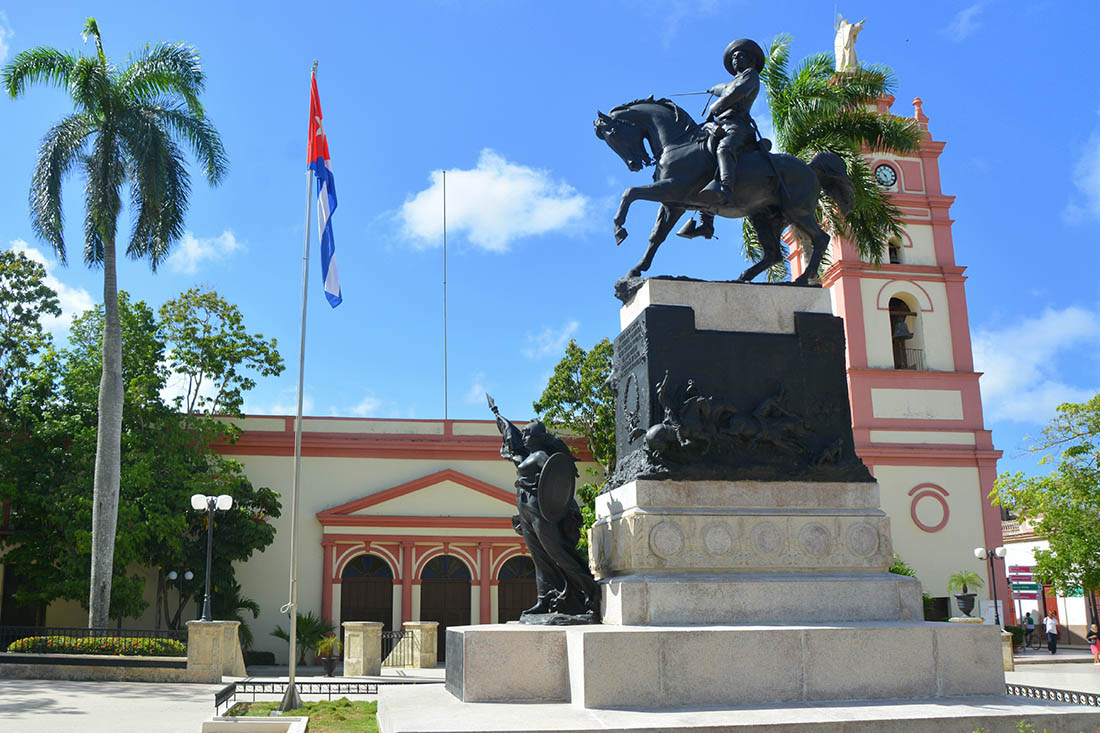
On February 24th, 1912, at 8 in the morning, Raúl Lamar, accompanied by the association’s board of directors, local and national personalities, but above all the entire town, sang the chords of the National Anthem by the Music Band of the Barracks under the baton of the mambí captain José Marín Varona. The hero’s widow, Amalia Simoni, unveiled the equestrian sculpture, and the vocal Walfredo Rodríguez gave the speech on behalf of the association.
Personalities present
Veterans of the War of Independence, Generals Javier de la Vega, Lope Recio Loynaz, Maximiliano Ramos, and Eugenio Sánchez-Pereira Agramonte. The first two, former heads of the Camagüey Third Army Corps. Jorge Roa Reyes, son of Ramón Roa, who kept the Mayor’s Campaign Diary, was also among the attendees.
Also Salvador Cisneros Betancourt, member of the Cuban Senate, and José Francisco Martí, son of the Apostle of Cuban independence José Martí, who was accompanied by his mother Carmen Zayas-Bazán. Of heroic significance, the women Gabriela de Varona y Varona and Ángela Malvina Silva y Zayas.
Legacy
The Italian artist Salvatore Buemi was crowned the winner of an international contest about the emblematic figure of Camagüey; and since 1912 his work is the attraction par excellence of the preferred park of the Historic Center, a World Heritage Site since 2008.
This iconic profile has penetrated so deeply that it is reinterpreted from other manifestations of art. In the cinema, for example, the director Rigoberto López Pego, between 2018 and 2019, directed the film El Mayor. The young artist Daniel Romero Pildaín manages to grasp the man, gives him a living, throbbing face, to the endearing posture of Ignacio when brandishing the saber in battle.
Translated by: Aileen Álvarez García