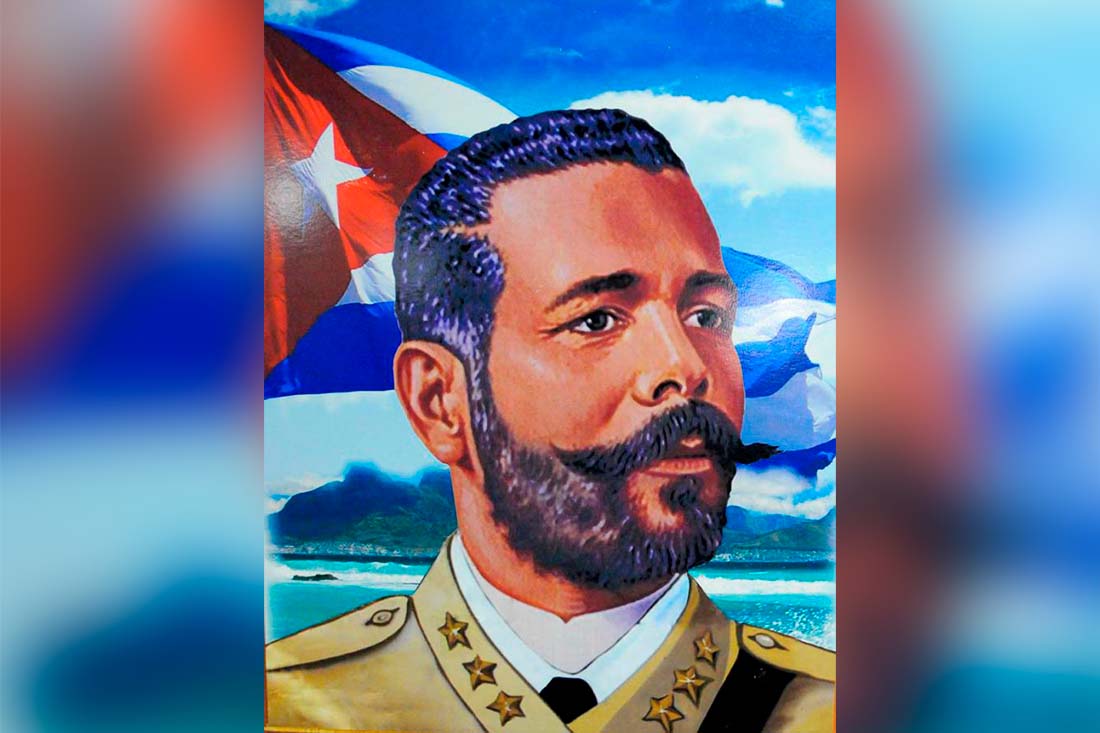
When Major General Antonio Maceo y Grajales was waging a successful campaign in the easternmost part of Cuba, despite the 81,000 troops that Valeriano Weyler had concentrated to kill him, his request for 500 men as reinforcement did not arrive. He did not have the consent of the Government of the Republic in Arms or the Delegate of the Cuban Revolutionary Party.
In these circumstances, Máximo Gómez, asked Maceo to move to Las Villas, “his campaign in the West declined.” Although reluctant to leave, because “his departure would prevent the achievement of our purpose, that is, to crown the Invasion with the Ayacucho.” Maceo, consistent with his disciplined character, decided that he should return, so he did…
Death disrupted the course of the war
The news of his death shocked the course of the war. Panchito Gómez Toro went out in search of his boss, his paradigm, his pride. He found the lifeless body, burst into woes of pain. A bullet knocked him down on Maceo’s inanimate body, and he wrote a suicide note to his family:
Dear mom,
Dad, dear brothers:
I am dying at my post, I do not want to abandon the body of General Maceo and I will stay with him. They wounded me in two parts. And in order not to fall into the hands of the enemy, I commit suicide. I do it with great pleasure, for the honor of Cuba.
Goodbye dear ones, I will love you very much in another life like this. Your Francisco Gómez Toro.
In Santo Domingo. Help yourself, friend or foe, send this paper of a dead man.
The historian José Luciano Franco noted. When five Spanish soldiers approached, Panchito was still alive, he was finished off by a Spanish pilot and the corpses were looted.
Silence pact
In the midst of so much despair, Colonel Juan Delgado, upon learning of the abandonment of the bodies, strengthened in fearlessness … and shouted: “whoever is Cuban, whoever is a patriot, and whoever has what he has to have …” eighteen men followed him for the rescue of the compatriots already lifeless. The corpses were transferred first to the Lombillo well, then to Cacahual.
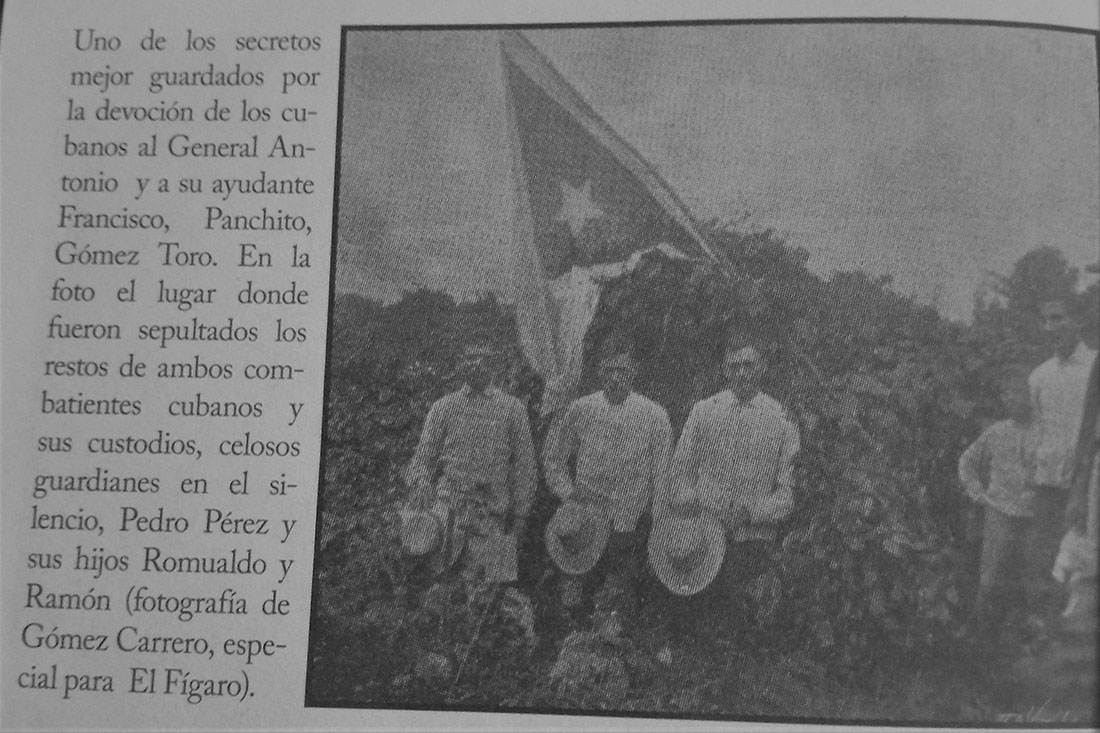
After a pact of silence, the burial place was not revealed. Pedro Pérez, a peasant from Havana, and his sons buried the remains of General Antonio Maceo and his assistant, Panchito Gómez Toro. The colonial power could never display the corpses of Maceo and Gómez as a trophy.
Transcendence of a paradigm
Maceo: representative of the most advanced political and social ideas, he was a living and active example, present in the front pages of the entire world press. They compared it with the military legends of Leonidas, Aquiles, Alejandro, Cesar, Aníbal, Napoleón, Espartaco, Bolívar, San Martín, O’Higgins, Sucre or Páez, liberators of peoples, referenced the intellectual Eduardo Torres-Cuevas.
Operation Tribute. Honor a hero
On December 7th, 1989, the date was chosen to give a moral commitment to the Revolution, to bring to the homeland, the remains of the internationalists who fell in allied countries, in fulfillment of military and civil missions, this is how the act of farewell to the mourning was held precisely in Cacahual, before the tomb of the undefeated Bronze Titan.
Throughout the country, the people dressed as militiamen, on the shoulders of women and men, the remains of the mortals of the internationalist combatants were deposited in the vehicles that would transport them to the trenches forever to where the new generations offer them every December 7th honorable tribute on a worthy date. Fidel Castro said: “The memorable date on which the most illustrious of our soldiers, Antonio Maceo, fell, along with his young assistant, was always of profound significance for all Cubans.”
Camagüey … For the fallen

The pilgrimage of the town begins every December 7th very early in the morning in the emblematic Maceo Square of Camagüey city; solemnly, the tribute reaches the General Cemetery. The Pantheon of the Fallen, while defending our country, is the site that keeps the remains of those who gave their lives on the battlefield.
Fighters of various generations, relatives, children, parents, friends, youth, the people in general join in the concert to honor those who infinitely deserve it.
Bibliography
Escalona, Israel y Torres, Damaris. (Coordinadores) (2016) Dos titanes en la historia de la cultura cubana. Editorial Ediciones Santiago, Santiago de Cuba, Cuba.
Franco, José Luciano, (1975) Antonio Maceo. Apuntes para una historia de su vida. Editorial Ciencias Sociales, La Habana, Cuba.
Torres-Cuevas, Eduardo (2012) Antonio Maceo. Las ideas que sostienen el arma. Imagen Contemporánea, La Habana. Cuba.
Translated by: Aileen Álvarez García