While the province was crossed by the invading columns of Camilo and Che at the beginning of the month, and the clandestine fight was increasing in the cities, in the plains of Cauto a column was formed that would have the Camagüey province as the headquarters of operations: the column No. 11 “Cándido González”.
The Commander-in-Chief appointed Captain Jaime Vega to head it. Fidel, in the meeting he held with the head of the column and the platoon that initially made it up, in the camp formed in Santo Domingo, explained the mission to be accomplished, as well as the difficulties and dangers they would have to face; emphasizing that for these reasons they could not use vehicles and that they had to take care of the enemy aviation, in order to avoid unnecessary risks.
In his usual way of talking to the combatants and showing them his confidence, Fidel let them know that many could die in the fulfillment of the mission, but he was sure that the survivors would fulfill it.
On September 8th, the column left the Sierra Maestra and on the 22nd of this month it entered the territory, by then it had traveled 200 km in 15 days, through a sparsely populated territory with little vegetation.
They arrived in Camagüey without the surprise factor, since the army of the dictatorship had been following their movements using aerial observation due to an incident at Las Margaritas junction, in the current province of Las Tunas. In addition, the passage of the invading columns of Camilo and Che had led to a concentration of troops and an increase in the repression of the farmers, in the route they had to follow.
The head of the column made contact with the coordinator of the M-26-7 in the Francisco sugarcane mill (later called Amancio Rodríguez), Dr. José Iglesias, who, among other things, asked him to find and locate some trucks to move around.
That night began the walk towards the Sitio Viejo batey, located next to the railway line that linked the Francisco sugarcane mill with the port of Guayabal. On the way, they learned that the army was ambushed in that direction and, taking extreme security measures, they reached the place.
After exploring, trying to locate the ambushes, they took the vehicles that the Movement had already placed at the agreed site and headed to San Miguel del Junco, 40 km to the west, where they arrived at dawn on the 26th. The batey’s neighbors, where Camilo and Che had been, welcomed the troops with big displays of hospitality.
That day it came to their knowledge that the enemy was moving towards that place, for which an ambush was placed on the access road and a 25-pound mine of explosives was planted. At approximately 4:00 pm, the rebel squad that was maintaining the ambush was put on alert, hearing the noise of a group of trucks. His boss, Aldo Ruiz, took the detonator and waited for the first truck to be over the mine: the explosion lifted the truck with its passengers amid a cloud of dust and smoke.
In this first fight, were killed three enemy soldiers and four were wounded. It could have been a crushing defeat to the army in the territory, but the chief did not count to engage in combat before he could reached his area of operations, and only the persistence of the army forced him to do so. Information about the movement of the enemy troops reached the column; two combatants from Macareño (former Macareño sugarcane mill, now Haiti), incorporated that day, reported that the Rebel Army had placed ambushes on the roads that connected the area with the Camagüey-Santa Cruz del Sur highway.
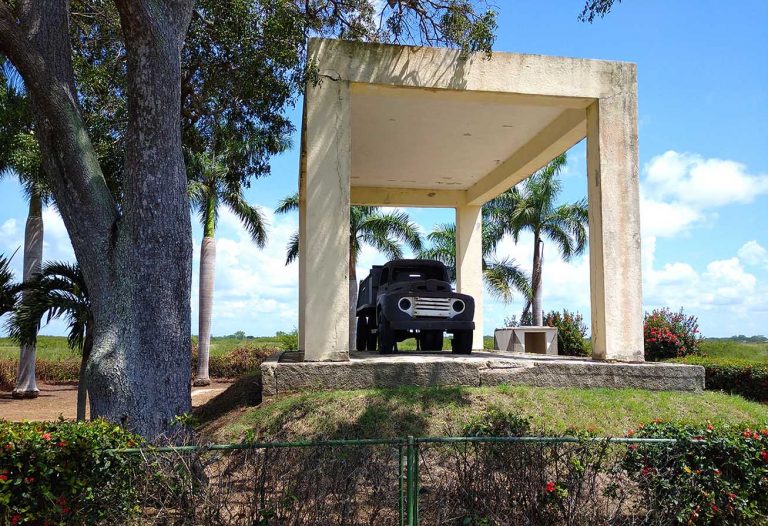
At dawn, on September 27th, 1958, a car and four trucks moved the column No. 11 “Cándido González.” When crossing the railway line near the Pino 3 batey, the car with the head of the column stopped, an action that was imitated by the four trucks that were following it. At that moment, the supposed guide, who was on horseback, passed the car at full speed screaming “finish them all”.
A first shot and then a closed fire from automatic rifles was heard from a fertilizer warehouse, and along a sugarcane field that lined the road; they had undoubtedly been ambushed.
In the midst of the attack there was no organized command of the rebel force, since the chief was traveling in the car and the main officers had passed the ambush. In the middle of the fight, some of the platoon and squad leaders tried to make themselves heard, giving orders to rescue the wounded and retreat to the mountains.
On the morning of September 27th, the members of the troop who had escaped from the ambush, including some wounded, were in the mountains of Laguna Grande. In Pino 3 there were more than a score of bodies scattered among the trucks, the embankment or among the trees surrounding it.
On October 17th, 1958, in the statement that analyzed the military situation, Radio Rebelde reported on what happened in Pino 3 and stated: “The setbacks must also be published, because we can learn useful lessons from them, so that the mistakes made by a unit not be committed by others, so that the carelessness that a revolutionary officer may have had is not repeated by other officers […] ”.
Translated by: Aileen Álvarez García