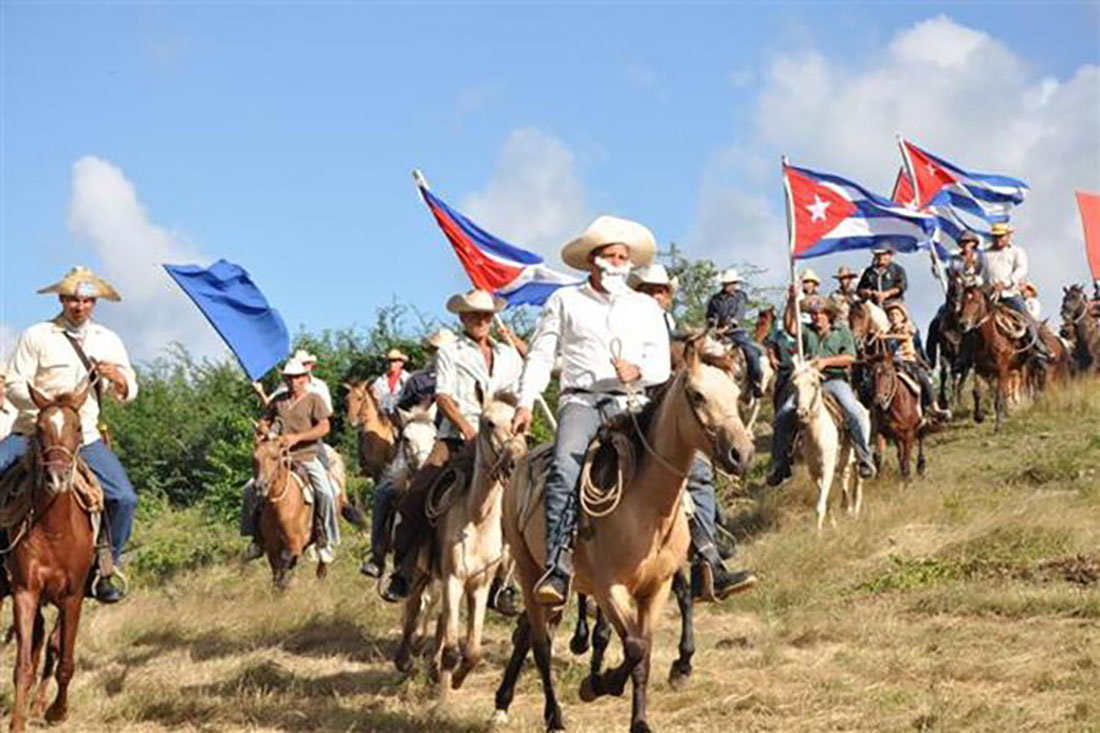
The delivery of the flag by Salvador Cisneros Betancourt to Antonio Maceo, not only meant the official dismissal and separation of the government from the mambí army, which since November 29th, 1895 had also joined its march to the Generalissimo; but also the reaffirmation of support for the invasion. The president, on behalf of the women of Camagüey and in a solemn act, personally deposits it in the hands of the Bronze Titan so that he could plant it as a badge of triumph in the Morro of Havana.
The emotional ceremony, carried out on December 5th according to the sources consulted, in which the patriotism, courage and intelligence of the hero were also rewarded, constituted the closing of a series of episodes and decision-making of great importance such as: the analysis of the strategic and political aspects of the invasion, which included the reorganization of the Fourth and Fifth Army Corps that would constitute the Western Military Department; the dismissal of General Masó from his post as Chief of the Second Army Corps for his regrettable conduct in such management, among others.
New designations
Likewise, the analysis carried out in a broad conference held by the great chiefs until December 1st in different camps would confirm Maceo in the position of Commander-in-Chief of the Invader Army, without thereby forgetting his other functions; Carlos Roloff as Secretary of War and Serafín Sánchez for direct command of the Fourth Corps.
Old problems
The formality, in a certain sense, left momentarily paused the conflicts that arose once the reunification of both powers had been established during the past days, on the courses of action, as can be seen in the letter from Cisneros to Estrada Palma, dated the 6th of that month, which exposes the need to avoid the slightest exposure to war and therefore bloodshed. Likewise, some issues were discussed, such as the transfer of Mayía Rodríguez from Camagüey, an option that the top leaders finally accepted, as they were planning to assign him to hold a position in the west part of the island.
The situations given were nothing more than a manifestation of the differences between the two commanders. However, the separation from the government responded to the request for their attention in other political matters of great interest, as well as in the need to arbitrate funds for the purchase of armaments.
Conclusions
The days between November 29th and December 5th, 1895, according to the texts examined from the bibliography, with their different versions and perspectives, were very important days, since the definitive organization of the invading forces was established.
Bibliography
Aparicio, Raúl. Hombradía de Antonio Maceo. UNEAC Contemporáneos. La Habana, 1966.
Cento Muñoz, Elda y Ricardo Muñoz Gutiérrez. Salvador Cisneros Betancourt: Entre la controversia y la fe. Editorial Ciencias Sociales. La Habana, 2009.
Gómez Máximo. Diario de Campaña (1868-1899). Instituto cubano del ferrocarril. La Habana, 1968.
Miró Argenter, José. Crónicas de la Guerra. T. 1. Instituto del Libro. La Habana, 1970.
Translated by: Aileen Álvarez García