By: Oreidis Pimentel Pérez
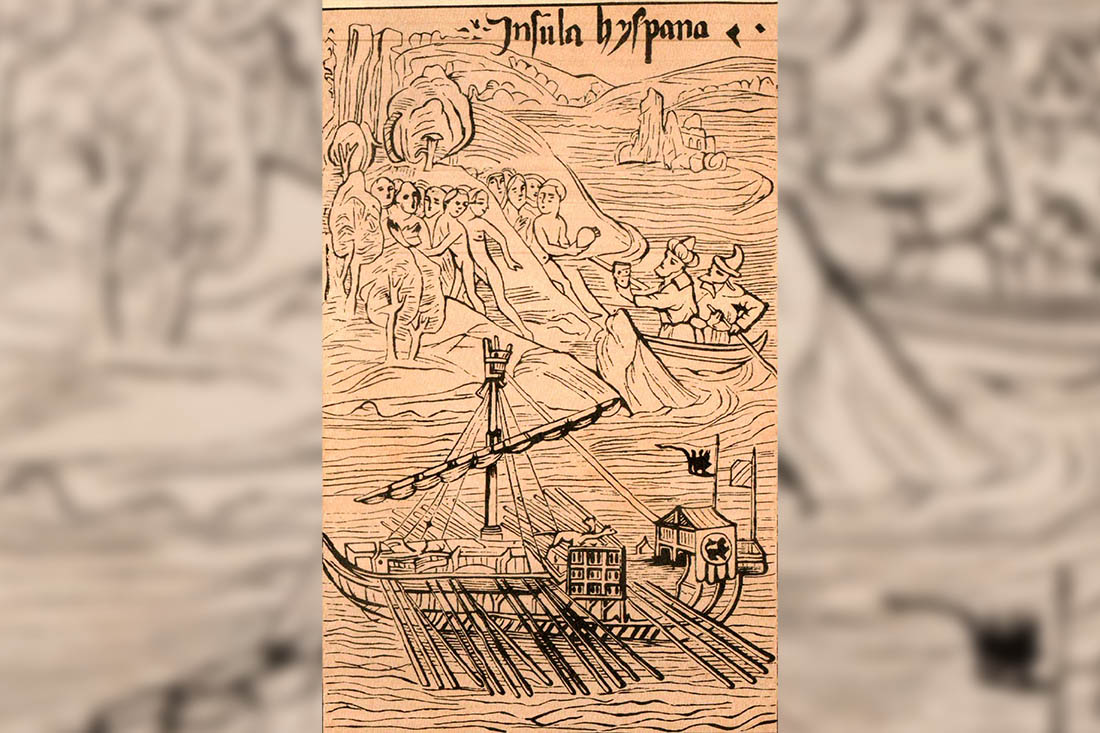
How could October 12th, 1492, and the commemoration of it today, be defined? We were told about the discovery of Christopher Columbus, but rather it was an encounter, since the continent and its inhabitants, no less human than the Europeans, despite the ecclesiastical rulings of the time, were always there.
Rather, that date was the beginning of an invasion, a conquest, of one of the greatest genocides in history; therefore, today, depending on the political will of the Latin American states, it is possible to find various denominations due to the advent of cultural shock and that, Solomonically, it was granted on a global scale as Day of Respect for Cultural Diversity or Day of Race.
Spanishness
Of course, in Spain the name “Spanishness Day” is a holiday and its celebration is something logical, because the Catholic kings managed to create an empire almost at the same time as they unified kingdoms and got out of the Arab yoke, thanks to a Genoese navigator. Columbus loaded what was left over towards where the sea seemed to end with some 400 sailors (many convicts and converted Jews), and with the wind sailing along the entire 28th parallel, the trade winds carried him to Guanahaní, almost to the point of mutinying the crew. . Later came Cuba, some say in Bariay, others PortusPatris; came the encomiendas and a chief Hatuey who did not want to go to heaven before Hernán Cortez subdued Tenochtitlán with Malinche’s secrets, or Pizarro cut off Atahualpa’s head in Cuzco. They say that they brought civilization against the barbarism of hearts in the Aztec temple, but in the opposite direction the dark inquisition burned the supposed heretics.
As the writer Eduardo Galeano said “from the point of view of the native, the picturesque is the tourist. From the point of view of the Indians of the islands of the Caribbean Sea, Christopher Columbus, with his feathered hat and red velvet cape, was a parrot of dimensions never seen before.”
Respect for Cultural Diversity…
Therefore, “Respect” or “Raciality” is rather a question of attempts to claim, because with the cross and the sword the civilizations on the other side of the Atlantic were crushed. There was not exactly a Hispano-American fusion-birth-culture, but rather the imposition of one over the other.
“Day of the encounter between two worlds” is another denomination used and that intends to examine the date from various aspects, although in the Bahamas the “Day of Discovery” seems to ignore that centuries before Christopher Columbus, the Vikings and Phoenicians had already been there. Peru does not consider it a great day (Inca gold is still in European museums), while Venezuela and Bolivia value October 12th from the indigenous resistance and the United States calls it “Columbus Day”, although it changes according to some states.
These are political-historical criteria, but in the end, October 12th also deserves the benefit of visions of what was new in Europe and what came from it. Galleon voyages were able to improve conditions: corn, tobacco, and cocoa became fashionable; Livestock brought new animals to the found continent and both Spanish and Portuguese were dotted with autochthonous terms, enriched over the centuries by the true fusion of Creole. Like the waves of the sea, it came and went, gold and silver to the east, many boats with Africans and Asians chained to the west. Through Castile and through León, Columbus opened a new era.
Translatedby: Aileen Álvarez García