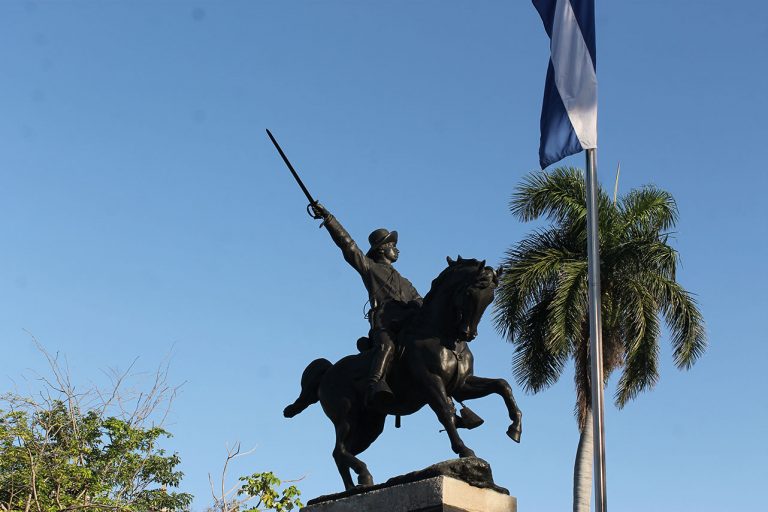
In 1873, military merits and triumphs in around a hundred combats, in addition to his archetypal personality, said a lot about the Man of Camagüey; Major General Ignacio Agramonte y Loynaz, as to fulfill bigger responsibilities in any of the positions of the Revolution.
Moreover, knowing his outstanding virtues, although it is worth clarifying, that nothing made him feel self-sufficient above the first in the Revolution and neither willing to behead or usurp undeserved positions.
Unfortunately, an enemy bullet would end his life on May 11th of that year. At a glance, no other officer seemed to replace him.
Searching among the chiefs of Camagüey
Brigadier Julio Sanguily had neither the military rank, nor the expertise, nor the leadership skills for that position. On his side, Commander Rafael Rodríguez, although he was the first officer of the General Staff, required more knowledge of military art and political skills.
Another Brigadier, Henry Reeve, had war experience of his nation, however to fill that vacancy he had to have the approval of the Government Chamber, that of the General in Chief and that of President Carlos Manuel de Céspedes, who had to decline it due to his North American origin. And one should not lose sight of the fact that those merits and qualities of the main leader of Camagüey made it more difficult to have the ideal man to occupy this position.
The decision of the head of Camagüey was born in the East
It was President Carlos Manuel de Céspedes whom had to approve to send Major General Máximo Gómez Báez to Camagüey. Gómez would not replace the Mayor, in any case, he would come to carry out that leadership with the same passion and strength as Ignacio Agramonte had done.
It was urgent to avoid the paralysis of the Revolution due to the loss of the leader, and for the enemy to take advantage of that state to attack the mambisado and advance towards the East. That was one of the objectives that the designated Major General had, and he would know how to raise the Revolution with the Major’s men.
Major General Gómez is not Major Agramonte
Gómez arrived at the San Diego farm on July 1st, “after such a long and tiring march”, a farm where he had his first meeting with the patriot and constituent Francisco Sánchez Betancourt, who communicated the first “confidences” about the situation of the territory, that is to say, the data collected by the secret communication agents disseminated throughout the region on a war footing.
After the talk, he directs “with practical and trustworthy men that Betancourt gives me” an urgent office to the acting head of the Brigadier Julio Sanguily Barracks, giving him an appointment at the camp located somewhat distant, La Horqueta farm, on July 7th.
After talking with Francisco Sánchez, on the 5th, Gómez was received “with admirable official attention and courtesy”, -he would write in his Diary-, at La Crimea camp by Brigadier Henry Reeve, from where he would continue that day to the Headquarters of the Cavalry Regiment, on La Aurora farm.
Lieutenant Colonel Federico Diago gave notice of the arrival of the “Major”. Reeve, on the spot, what would be recorded for the history of Cuban struggles, stressed that: “the Major had been one and had fallen in Jimaguayú.”
We believe that it was not an expression to lower the hierarchy and merits of the new boss; The phrase came to him sincerely because of the man who had fatally tried to get him out of the ambush when he was surrounded by Spaniards in Jimaguayú, on May 11th. Rather, it was the emphasis on the leader that was still present.
Major General Gómez takes over Camagüey
At La Horqueta Gómez farm, he received the Camagüey Military Department on July 7th. That day he wrote in his diary: “After I have presented Sanguily with the orders of the Government, I have been taken over, without ceremony, of the Department. I call the whole force and I intend to speak to them, but I am impressed and I can hardly coordinate the ideas”.
On the morning of the 8th, he reviewed the troops, and wrote: “In view of this small body of the Army, but well ordered and organized, no wonder i felt deeply concerned with the vivid memory of General Agramonte (…) Agramonte, inspired in pure patriotism left the Revolution assured in this part (…) ”.
Finally, to Antón de Guanausí, on August 10th. After this the “Major” Gómez intensified the campaign to evict the Spanish. And for that task he had to invoke the memory of the undefeated Major Agramonte.
Translated by: Aileen Álvarez García