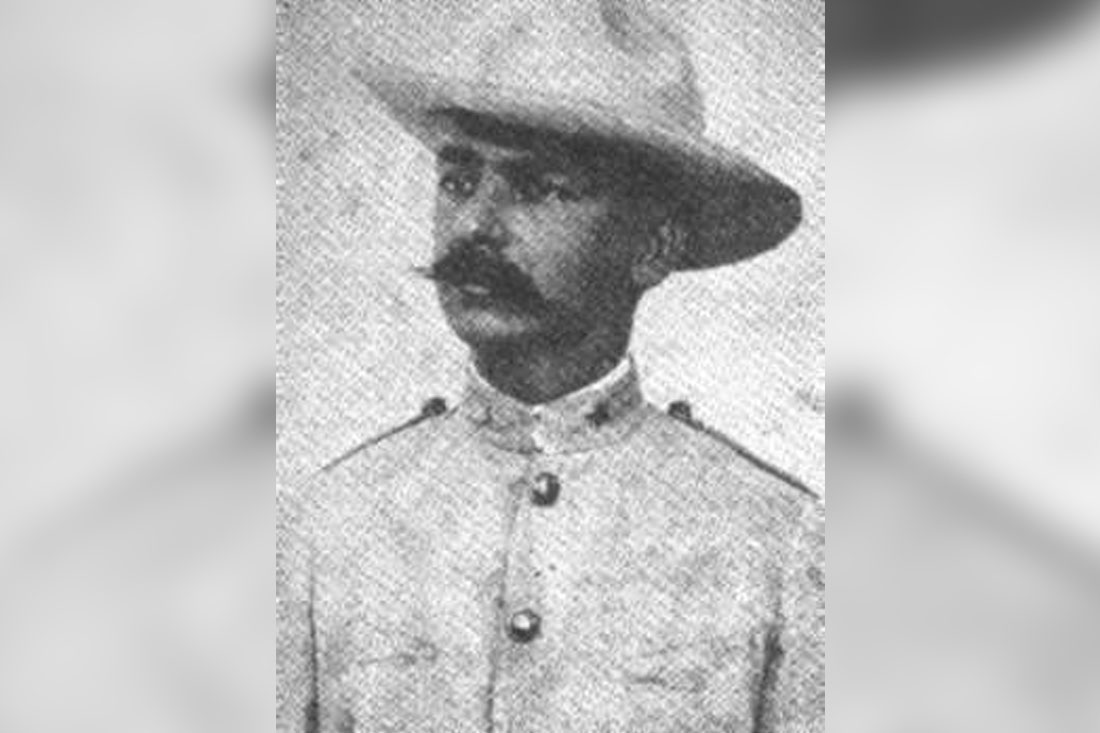
A few years ago I heard the name of Eugenio Molinet Amarós for the first time, through my uncle, Dr. Manuel Oliva Palomino, who did justice to him for his contributions to the insurgent military healthcare in the war of 1895.
The historian and researcher Desiderio Borroto Fernández dedicates an article to the patriot in Cuadernos de historia Principeña no 2.
Who was this doctor and combatant who left an inescapable mark on the independence struggle of 1895?
The short answer can be written in a few words, Guaimaro patriot, born on March 29th, 1865, obtained his title as surgeon and pharmacist on October 11th, 1889 and made his knowledge and courage, among other merits, available to the country since 1895 in the insurgent camps.
However, few words are not enough to know about his work, his professional beginnings in Melena del Sur, his contribution as a doctor, his work in the Ministry of Agriculture, Commerce and Labor, and as director of the Commission of Historic Places of the province of La Havana that distinguish him as a man of his time.
Indelible work
He joined the independence strugles in 1895, the conspiracy tasks related to Juan Gualberto Gómez, led to the suspicion of the colonialist army and his decision to flee to the insurgent fields of Camagüey to meet the family of Eugenio Sánchez Agramonte.
He initially fought under the orders of Máximo Gómez, he was appointed doctor of the General Staff. On December 14th, 1895, he was appointed Chief of Military Health of the Third Corps of the Liberation Army, for the knowledge applied in the campaign and the courage in the combats of Altagracia, Ceja de la Larga, Cascorro, El Congreso, Saratoga, and Las Tunas was promoted to brigadier general.
Hospitals in the battlefield
Among his merits as Chief of Military Health stands out his efforts to create hospitals for medical care in the battlefield, he was helped by those mambisas such as Mercedes Sirven and Rosa La Bayamesa, who had experience in caring for the wounded and sick from their knowledge of medicinal herbs. He held various responsibilities in the Military Health, a setting where he made indisputable contributions as a doctor.
On the other hand, he establishes surveillance and health control measures, isolation to prevent the spread of diseases such as smallpox, cholera, yellow fever, dysentery, among others. On January 10th, 1897, he delivered the “Military Health Instruction Booklet for practitioners and nurses”, which allowed the dissemination in the mambisa forces of that essential knowledge for wound healing, medical maneuvers, treatments, and the use of natural medicine.
At the end of the independence struggle he returned to Havana, he practiced his profession in different places in Cuba, during the government of Gerardo Machado he held the position of Minister of Agriculture, Commerce and Labor. Molinet received the National Order of Merit Carlos J. Finlay in the Grade of Grand Cross.
Some historians misjudge this patriot, decontextualize the times he lived in and his contributions to the Cuban nation. He passes away on May 15th, 1959, at the age of 98.
Translated by: Aileen Álvarez García