by: Dairel Arcos
Being from Camagüey implies being knowledgeable about our history, it means understanding that others value our way of speaking the Spanish language, it means that we have a local culture that spreads throughout the country, and of course there is the fact of proudly having another name: Agramontinos, that it is already a challenge and a great responsibility.
In these times of pandemic, where humanity resorts to new ways of subsisting, to new paths of hope, there are those who take refuge behind a brush and fill their lives and those of others with meaning.
Today we want to reclaim our homeland, because we must not forget that we are privileged to be from the same country of the incomparable Fidelio Ponce de León.
Now that the world is suffering, a totally valid question comes to mind in this context: what would Fidelio, the painter of human misery, have painted? Someone so attached to suffering and rejection, but that never lost his faith and clung to life; and he did cling to life, with an existence that he captured on his canvases full of melancholy.
Sometimes children were the protagonists, other times you had to paint to eat and continue painting, that’s why Ponce de León marked his paintings with two letters: FF, for those who accepted his paintings in exchange for a plate of food, perhaps they had no idea about the meaning of those two letters, which simplified the phrase: For Food.
Our Fidelio
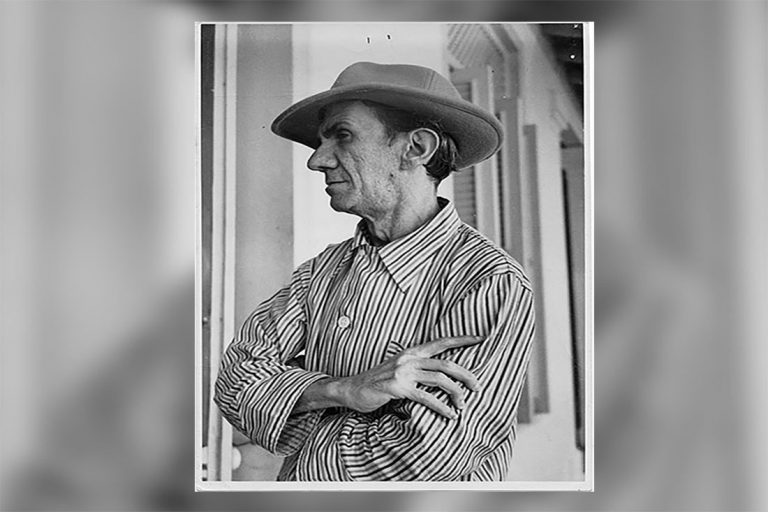
Born in Camagüey on January 25th, 1895, his real name was Alfredo Ramón Jesús de la Paz Fuentes Pons, Fidelio Ponce is the emblematic painter of our city, one of the great masters of Cuban painting and an mandatory reference of the avant-garde together with Carlos Enríquez, Víctor Manuel or Amelia Peláez.
Unfortunately, Fidelio was mistreated by the society in which he had to live and sought refuge in his inner world, even so, he gave life to forgotten places, always portraying the humble and even in his walk through life he taught children to paint and discover the magic of colors; perhaps that is why history wanted one of his most recognized paintings to be titled simply: Children.
His last years were not the healthiest, but Fidelio continued painting with all his might, from this period relevant works such as Tuberculosis and Beatas were born.
On February 19th, 1949, he died in Havana at the age of 54, probably with ideas to carry out, but totally convinced that he was living the life he wanted to the full. He was buried in the Colón Cemetery, in Havana, a place that worthy of him because he is Cuban, not by right, Ponce de León will one day return to Camagüey to stay, or better yet, to continue painting.
To pay tribute
In the heart of the Office of the Historian of Camagüey city (OHCC), it is located the Fidelio Ponce de León Art Gallery, a place that feels proud to bear the name of the distinguished artist from Camagüey.
A privileged space for good art, not only from our province, but also for Cuban art. Local and national artists have exhibited their works to the delight of an ever-knowledgeable and demanding public.
About the project…
From the Fidelio Ponce Gallery, the Carmen Socio-Cultural Project was born, which aims to work with the community, prioritizing work with children, an essential audience in the activities.
Our specialists mainly work in children’s educational activities, where Plastic Arts play a very important role.
The activities are not only carried out in the Gallery itself, they also take place in the community, specifically in the Carmen neighborhood. Each one contributes to the general and integral culture that our people need from an early age, always consistent with the OHCC’s social mission, preserving heritage, identity, traditions and providing feedback with the premise of enjoying and learning.
In our catalog of activities, those of Plastic Arts stand out, such as: the Appreciation and Creation Workshops, Getting to know the artists of my city, a meeting between the children and the artist himself, Between Columns, a discussion on topics of interest referring to the plastic arts and its creators. Also the Workshop of Legends and Traditions, a propitious space for the history and fantasy that surround the people of Camagüey.
The Cinema Debate is another activity, with the projection of educational and artistic audiovisuals that promote comments and communication among spectators. In the Carmen Square there are activities such as Painting on the cobblestone and Playing, both promote creativity, teamwork and of course good clean fun.
Undoubtedly, the activities of great relevance for our institution are the exhibitions, always trying to show the diversity of the Plastic Arts in their manifestations to all audiences, keeping alive in each exhibition, whether personal or collective, the spirit and the legacy of Fidelio Ponce.
Translated by: Aileen Álvarez García