The Historic Center, the main witness of the patrimonial wealth of the city of Camagüey, was declared a National Monument on November 10, 1980; It has an approximate area of more than 300 hectares and is considered the largest in Cuba. To preserve and enhance the many values treasured in it, it is the object of constant professional work, which currently exhibits encouraging results.
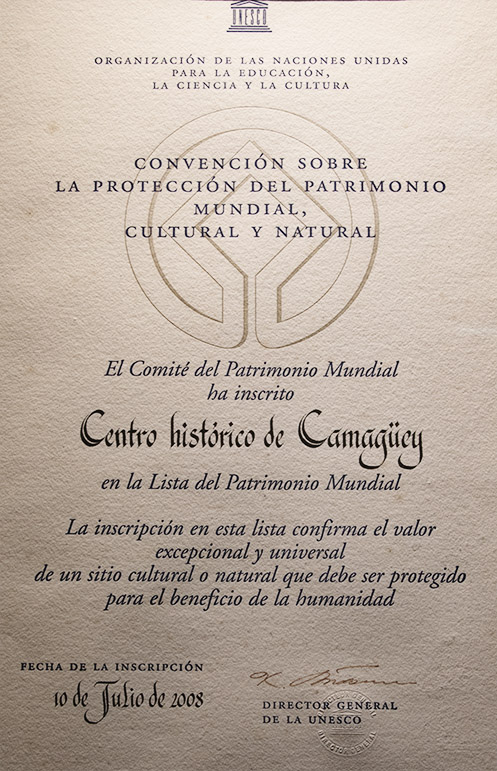
In the Historic Center, mostly residential, there is a population of approximately 58 200 people, with a crowding coefficient of 3.9 and a density of 194.29 inhabitants per hectare. To vindicate its indisputable conditions of exceptionality, a dossier was presented to Unesco with the proposal of including an area representative of it in the World Heritage List; proposal that was approved on July 7, 2008, at the 32nd meeting of the World Heritage Committee.
The area declared Cultural Heritage of Humanity has a surface area of 54 hectares, 80 blocks and 83 valuable buildings. This comprises the oldest nucleus of the city and the Historical Center, as well as the five spaces that marked its origin: Parque Agramonte, Plaza del Carmen, Plaza de San Juan de Dios, Plaza de los Trabajadores and Parque Martí.
The synthesis and sediment of the various cultural expressions and the different stages of their evolution is present on it.
Traveling through this area allows you to appreciate magical urban environments intrinsically linked to history and culture, where architecture and urbanism are the result of human imprinting in each period.
The complex system of squares -where the combination temple, parishioner, square and layout, typical of the Hispanic Christian city harmonize magnificently- it is complemented by civil and domestic buildings conjugated in a unitary, but heterogeneous whole, and with a rich intangible heritage full of legends, traditions, living customs and a remarkable cultural development
The Historic Center of Camagüey constitutes a relevant example within the set of colonial cities. Its well-preserved religious repertoire, the atypical irregular urban layout that remains valid in the present, its high environmental and contextual value; as well as the wise conjugation of past and modernity, they determined its inclusion in the World Heritage List.
Translated into English by Yisel Torres Ruiz