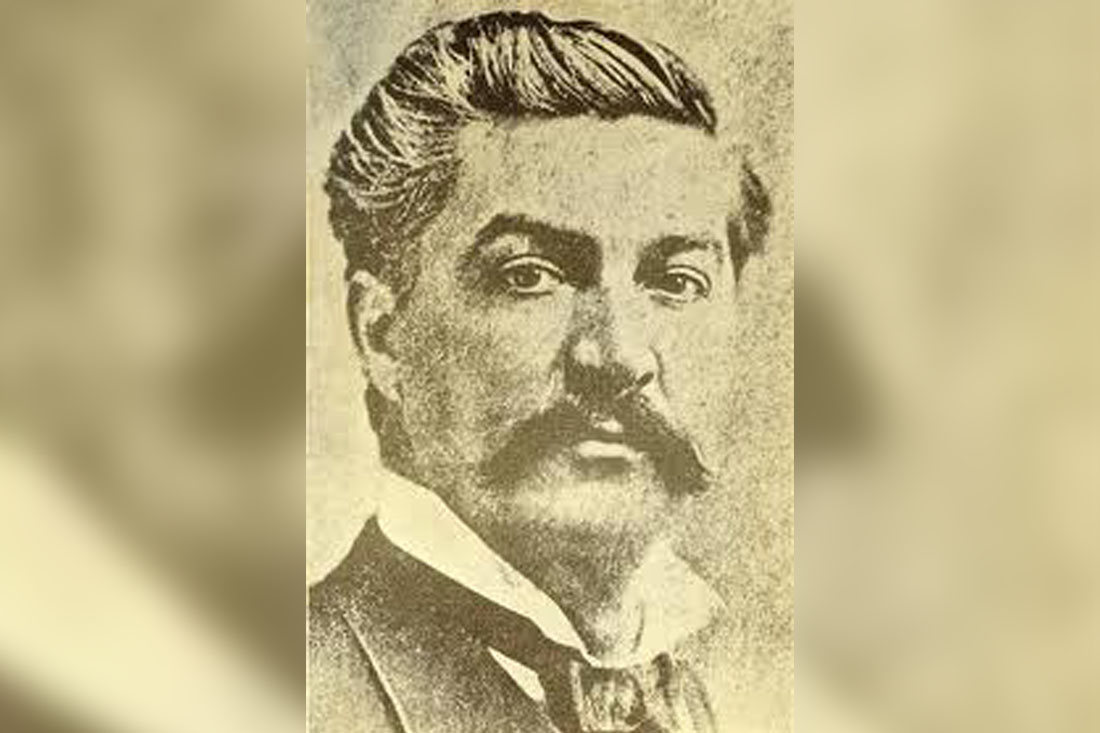
Manuel de Quesada Loynaz was born in Puerto Príncipe on March 29th, 1833. He was a member of the secret independence organization Libertarian Society of Puerto Príncipe. His decision to support the uprising of Joaquín de Agüero in 1851─although it did not happen because the leader was taken prisoner─ it cost him to remain semi-clandestine until he was able to leave the island on July 31st, 1855.
His outstanding participation in the Mexican war with the Liberals, in the 1857-1861 Reform War, allowed him to earn the rank of Colonel. He organized the Lanceros de Quesada cavalry corps and according to the Encyclopedic Dictionary of Military History of Cuba, fought multiple battles in a short time. He attained the rank of Major General after the war concluded in 1867.
Back to Cuba during the Great War (1868-1878)
On September 1st, 1868 he arrived in Nuevitas via Nassau to join the uprising, but Napoleón Arango misinformed him and when he returned to New York he was surprised by the Yara Cry. However, he organized an expedition in the schooner called Galvanic and landed with 60 men in the Piloto swamp, north coast of Camagüey. He also brought 2,540 firearms, 150 rifles, half a million bullets, a cannon, among other supplies.
On December 31st, 1868, he was appointed by the Central Revolutionary Committee as General in Chief of the Camagüey forces. He attended the Constituent Assembly of Guáimaro, not as a representative, and there he was appointed General in Chief of the Liberation Army on April 11th, 1869.
He knew how to demonstrate his organizational skills and the experience he gained from the Mexican war. He restructured the troops, established gunpowder factories and saddlery workshops, promoted farming areas and salt flats, and created a system for logistical assurance.
He won battles and also entered into a dispute with the members of the House of Representatives, since his functions were constantly limited by the intervention of civil powers, he alleged. Faced with his demand for the centralization of military command, he was censured by many as a person who wanted to establish a military dictatorship.
On December 17th he was forced to resign, although the Chamber had already agreed to his dismissal.
Special agent of the Cuban government abroad
On January 3rd, 1870, Carlos Manuel de Céspedes appointed him as a special agent of the Cuban government abroad, in order to raise resources for the war. From this position he organized several expeditions, such as the schooner J. Adams, evicted on January 17th, 1871; the steamer Virginius on its third voyage all the expeditionaries were captured. In this event, his son Herminio was shot.
In 1872, Céspedes suspended the General Agency in New York and appointed him a confidential agent. After the dismissal of Céspedes on October 27th, 1873, the government of Salvador Cisneros dismissed him, although he continued to travel for the same purposes.
The signing of the Zanjón Pact, on February 10th, 1878 surprised him outside the country, in Costa Rica. He managed to be superintendent of the railways and influenced the development of this economic line in this country.
His death
He died of pneumonia in San José Costa Rica on January 30th, 1884, his remains remain there.
Bibliography
Diccionario Enciclopédico de Historia Militar de Cuba, Primera parte (1510-1898) Tomo 1. Biografías. (2014) Editorial Verde Olivo, La Habana, Cuba.
Translated by: Aileen Álvarez García