I am from Matanzas. I love my city of rivers and bridges and really appreciate its tricentennial history. However, for two years I have lived in Camagüey. Personal reasons brought me here and in this short time that I have been in “the pleasant region of shepherds and hats”, I have noticed some historical coincidences between my native Matanzas and Camagüey. Beyond the rivalries established in the 59th National Baseball Series between crocodiles and bulls, I would like to reveal, with this attempt at a historical account, some milestones and processes that connects in one way or another the two territories..
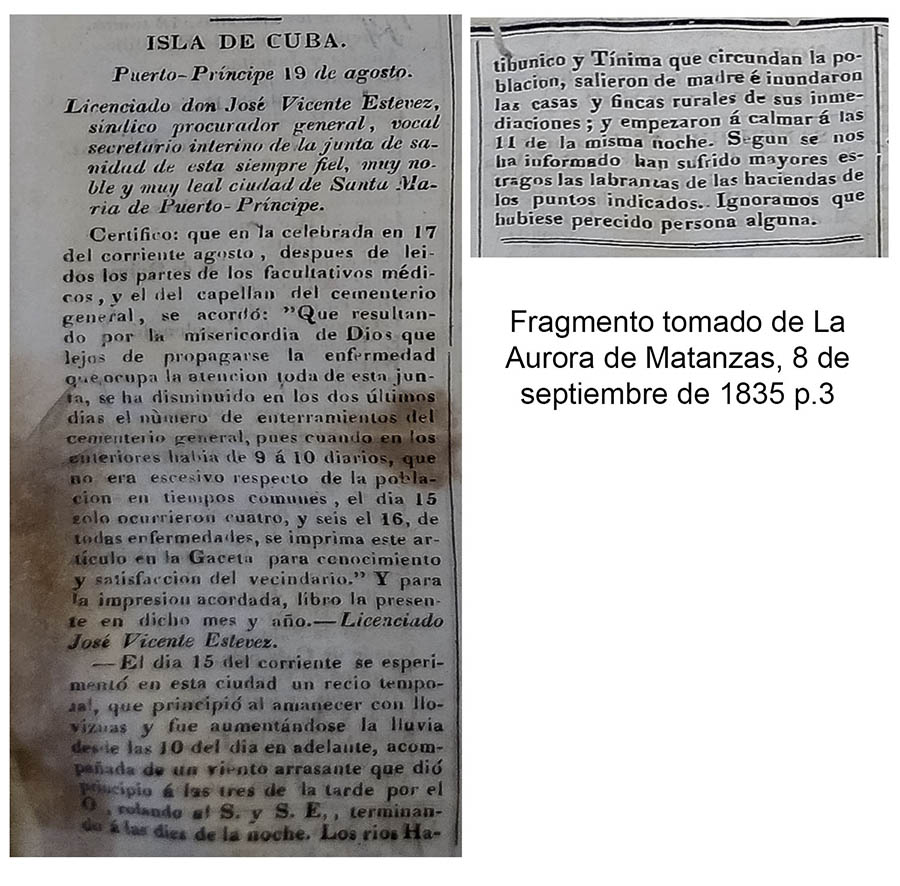
First of all, I want to refer to the relationship between La Aurora de Matanzas newspaper and the Gaceta de Puerto Príncipe newspaper. In 1828, La Aurora de Matanzas newspaper was published, owned by the local Patriotic Council and which would mark the coming of age of Matanzas journalism. This publication was a newspaper that played an important role in Matanzas during the 19th century and it is significant the relationship it established with its colleague Gaceta de Puerto Príncipe, from as far back as 1829. The Matanzas newspaper constantly took fragments of news from the Camagüey newspaper, summaries of court orders and other information of interest; and inserted them in the section Excerpt from newspapers on this Island. In this way, the public was kept updated on events in other locations, since it should be understood that at that time there was no other means of communication other than the written press.
Another of the surprises about Camagüey that the Aurora de Matanzas keeps is the publications of Don Esteban Pichardo, a prominent geographer from Camagüey who wrote very interesting articles on the cartography of the Western Department. Pichardo began to write his geographical studies on the Yumurina city in La Aurora, mainly in the 1840s. Without being from Matanzas, he carried out research and contributions to the city. His passion for geography is hidden and well protected in the Matanzas newspaper.
On November 22nd, 1845, Esteban Pichardo published a detailed description of a map of Matanzas. The scientist explains “I have begun by drawing on a larger scale of the most populated, rich and interesting part of the island, including the jurisdictions of Havana, Matanzas and Cárdenas.” It is striking that the works of this scholar were very detailed descriptions and sometimes included up to 3 columns.
Later on August 15th, 1846, Pichardo republished another work that he called Map of Matanzas, but this time under the auspices of the Governor Don José Falgueras. All these articles are results of the work of this intellectual who used La Aurora as a source to publicize his research; Also, he took this opportunity to announce the sale of his maps. At the end of the article, as a note and before signing it, it says: “On sale for (sic) three and a half pesos in the office of this printing company.”
On March 21st, 1851, the newspaper La Aurora announced in one of its sections the sale of the Geotopographic Chart of the Western Department by Pichardo. This time, it says “available on the store at (sic) doubloon of four each of the pages, the second of which includes Matanzas, Cárdenas will come out to (sic) in a few days.”

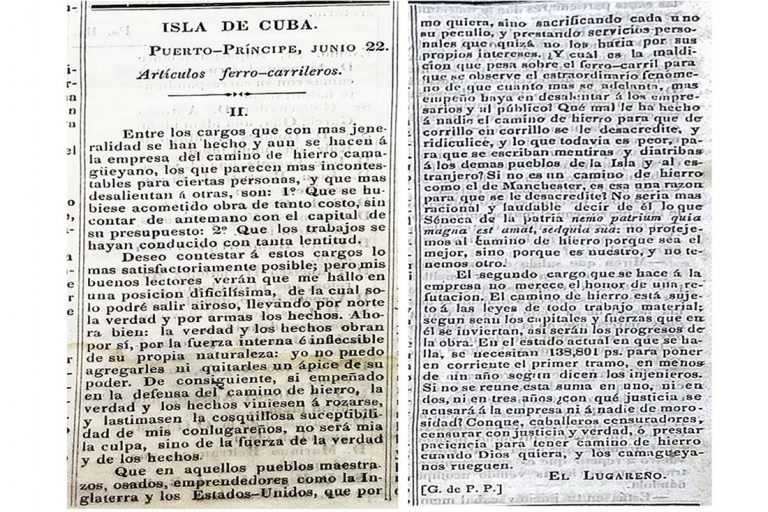
In the newspaper Aurora de Matanzas you can read several of the Lugareño railroad articles. The Camagüey professor and researcher Dr. María Antonia Borroto, in the prologue of the book Everyday Scenes, by Gaspar Bentacourt Cisneros (2017) reflected: “I owe the historian Ricardo Muñoz a fascinating fact: in La Aurora de Matanzas, i could read texts by El Lugareño . ” This is true. On July 3th, 1841, La Aurora de Matanzas published a work entitled White Colonization under the signature of El Lugareño.
On July 5th, 1843, another work by Betancourt Cisneros was published again in La Aurora.
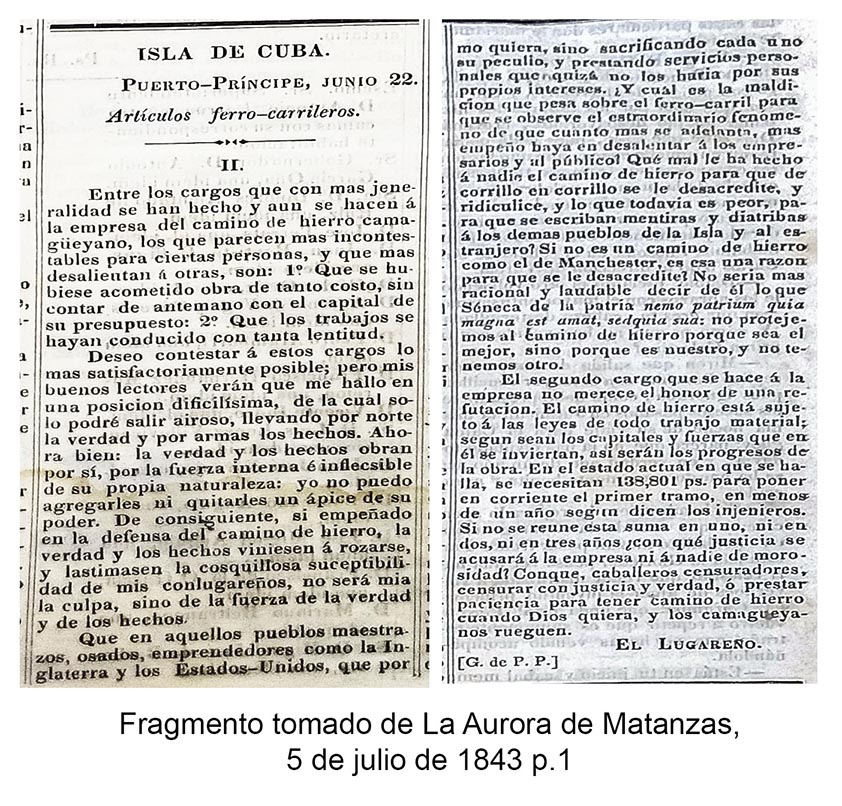
This time one of his railroad articles is unveiled. Finally, on May 15th, 1845, the newspaper La Aurora publishes another Railroad News of El Lugareño. Taking into account the importance of the railroad for Cuba and for the Matanzas of the 19th century, it is not surprising that all news related to the “iron roads” was interesting for the editors of the newspaper.
It is also significant to find in the Matanzas newspaper several poems by Gertrudis Gómez de Avellaneda. One of them was published by the newspaper La Aurora, on October 16th, 1850 and is entitled La Cruz.
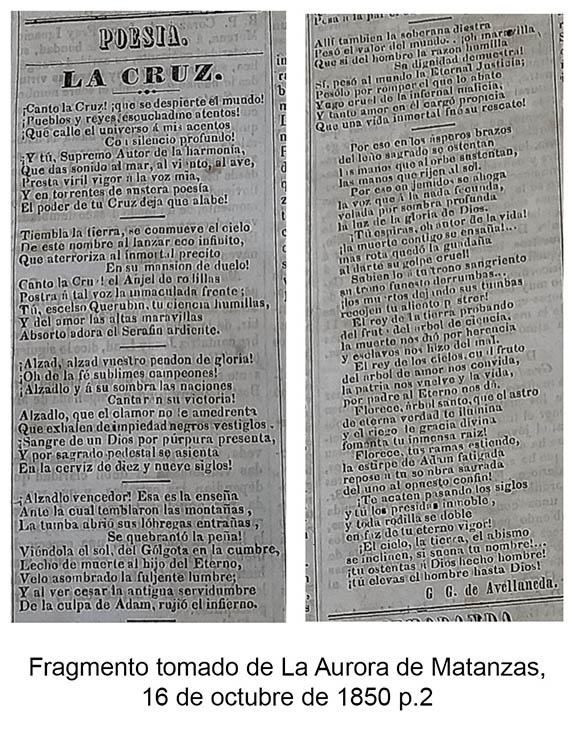
Another of Avellaneda’s verses was published on January 7th, 1851, the poem she wrote to celebrate the inauguration of the Royal Theater in Spain. In the year 1851 itself, it can be found in La Aurora de Matanzas Adiós a la Lira, a poem by the Camagüey author.

It is not known for sure how the news from other newspapers reached La Aurora de Matanzas newsroom. Presumably, as La Aurora itself had subscribers in various territories, the directors and editors of the newspaper had access to all the materials published in the “fellow” newspapers. What is certain is that through the pages of the Matanzas newspaper one could learn about life and the main events of the nineteenth century, mainly those of Camagüey.
Bibliography:
- Betancourt Cisneros, Gaspar (2017 2da e). Ediciones El Lugareño. Camagüey.
- Dollero, Adolfo (1919). Cultura cubana. La provincia de Matanzas y su evolución. La Habana: Imprenta de Seoane y Fernández
- Labrada Rodríguez, Eduardo. (1987) La prensa camagüeyana del siglo XIX. Editorial Oriente. Santiago de Cuba.
- Martínez Carmenate, Urbano y Ruiz Rodríguez, Raúl (2006). Las cifras del tiempo. Cronología histórica de Matanzas 1494-1867. Matanzas: Ediciones Matanzas.
- Periódico La Aurora de Matanzas 1835-1851.