It would be three in the afternoon on June 8th, 1865 when in a classroom of the Royal and Pontifical University of Havana where he would pick ballots 2, 8 and 57, while the Bedel would read their contents. After hearing the last word, the applicant would choose ballot no. 2 that made reference to the Study under the point of view of the rational principle, on the law reformed by Justinian in comparison with the one before his time. A subject that was very difficult to broach, although not for Agramonte, who had in his blood the codes of family inheritance, and who had devoted himself so much to studies that for that reason would come to make those with his surname proud who had previously chosen the path of the laws.
After three hours in solitary confinement to prepare the dissertation, Ignacio Eduardo Francisco Agramonte Loynaz would speak “by voice” with ease.
After listening to his presentation, and without the intention of additional questions, the doctors certified the “particulars of Outstanding”. Two days later, at 11:00 am on June 11th, the investiture ceremony would take place as a Bachelor of Civil and Canon Law. Maybe he was a little nervous at the moment of so much happiness. He would look elegant wearing a toga and bonnet. He had overcome one of life’s tests. And others, perhaps more difficult, would await him.
The corpus of his project
He thought from the university classrooms that Cuba needed a change of structures on an island colonized by a centralizing and absolutist state; because there were no full rights and freedoms; because there were no guarantees of justice or social equity. The State deserved to be restructured, to give the citizen the freedom to think and act; make it worthy of dignity, culture and full knowledge. Break with what he would have called; the “veil of ignorance among men”, guaranteeing work and a dignified life, with “imprescriptible and inalienable rights” as the “Creator” would have so arranged. In two words, Ignacio Agramonte advocated for a more just and humane society, however, which was not yet within the reach of the historical moment.
His humanism at the center of the project
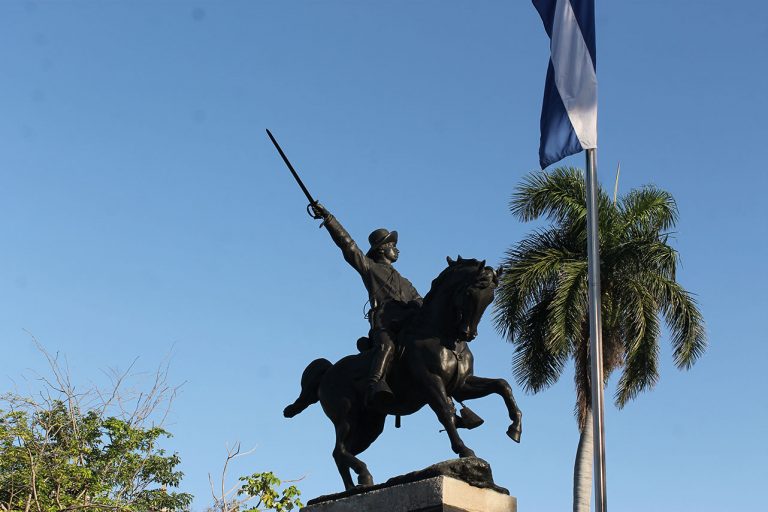
The Bachelor of Civil Law would go on to join the Ten Years War, on November 11th, 1868. From that moment on, his legal intervention in the structuring and organization of the State of the Republic of Cuba in Arms would be crucial. It would not be just a matter of arming the Liberation Army with the most effective cavalry weapon that he could achieve, as he really would.
Let us remember his letter to his wife Amalia, dated June 9th, 1869, in which he warned early on that he was forming a cavalry squad that would leave the Spanish cavalry behind, that is, create a weapon capable of stop the Spanish offensive, that intended to annihilate the Revolution, and thus be able to guarantee the survival of the Rule of Law of the Republic of Cuba in Arms and thus achieve victory. It was also to guarantee the integrity of the President and his followers. Therefore, the lawyer from Camagüey would request the lawyer from Bayamo, elected President in Guáimaro, to confer full military command of his native region to raise the revolution and break the Spanish military power.
Thus he put himself ahead of any caudillista vision that was claimed to be attributed to him, proving only his sincere love for Cuba. And with no other personal goals than to draft the articles of the Fundamental Law of the Republic that would be confirmed in Guáimaro, to draft the decrees of Administrative Organization, Civil Regime, Judicial Administration, Extinction of slavery, Compulsory military service and others, with the objective of endowing the Republic in Arms with institutionalism. The State with all its structure represented, —even in a situation of war and Hispanic military and administrative occupation—, at the same time that the war of independence would be carried out to make it feasible. That would give Cuba prestige before the world. That is why his high-sounding phrase: “May our cry be forever: Independence or Death”!
For the Major, nothing should hinder independence, supreme principle which law of the Republic in Arms. It was the highest justice that all the inhabitants of the island-archipelago could deserve, as it was set out in article twenty four of the constitution. Inspired by the French democratic triptych adjusted to the historical situation of the Island; achieve freedom, equality, justice and the full rights of all its citizens. This is how the Cuban future must have sensed the Chief Advocate for the Independence of Cuba, who would fall in Jimaguayú for enforcing the law.
Translated by: Aileen Álvarez García