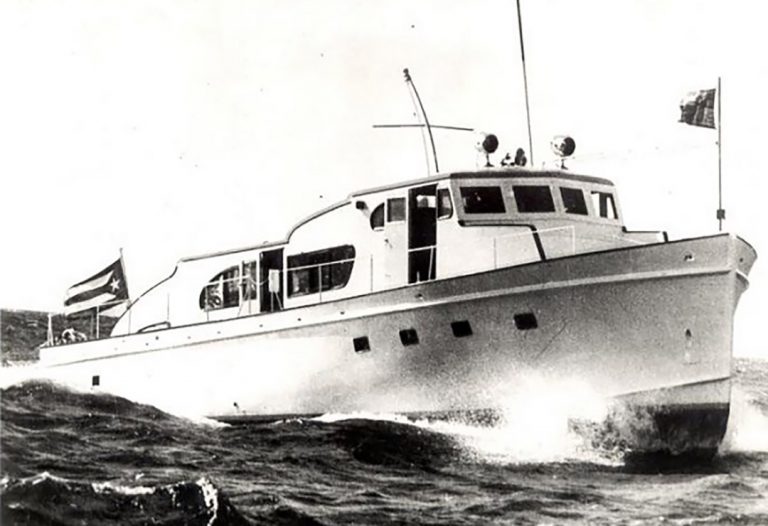
64 years after the departure of the yacht Granma from Tuxpan, Mexico, we feel we have the duty to recall such an important event where not only the worth of the Cuban people was demonstrated, but the integrity of those men who gave their lives for the freedom of the Cuban nation.
In the early morning of November 25th, 1956, the yacht Granma, a pleasure boat designed to accommodate no more than 6 or 7 people, began its journey from the Mexican port of Tuxpan to Cuba, sunk above its waterline due to 82 expeditionaries, weapons, ammunition, food and tanks full of oil. It was carrying more than it could and to a certain shipwreck in the face of the unpredictable rough water of the Caribbean Sea.
Of the 82 expeditionaries, led by Fidel Castro, there was one from Camagüey and two who were as if they had been since all their revolutionary work was carried out in the province of Camagüey. They were Calixto Morales Hernández, a Cuban revolutionary fighter, member of the July 26th Movement and captain of the Rebel Army, who was born in Florida and was appointed by Che, in the Battle of Santa Clara and after the triumph of the Revolution he held various positions in the leadership of the State; and the other one, Reinaldo Benítez Napoles, born in Bayamo, but at an early age he began to live in the city of Camagüey, where a patriotic ideal was forged that led him to be a member of the July 26th Movement, an assailant of the Moncada barracks, a member of the Orthodox Party and after the coup d’état of March 10th, 1952, opposed to the dictatorship of Fulgencio Batista and fought until the triumph and maintenance of the Revolution.
Another of the great revolutionaries was Cándido González Morales who was born in Puerto Padre, today the Las Tunas. His parents transferred him to the city of Camagüey in the 30s, he was a student leader and a Cuban revolutionary fighter who was part of the Orthodox Youth, he worked for the sake of the creation of the July 26th Movement. Due to his constant participation in revolutionary activities, he was a victim of persecution, arrests and threats. Cándido González was a consistent man in the fight to make Cuba a country where education, health, childhood and libertarian principles governed the lives of Cubans. Just three days after the defeat in Alegría de Pío, and on December 8th, 1956 in Boca de Río Toro (30 km southeast of Niquero) he was killed by soldiers from the Batista dictatorship.
The arrival of the yacht Granma marked the beginning of the guerrilla war in the eastern hills of Cuba. In those remote places, the blood and sweat of men and women forged the Revolution that triumphed on January 1st, 1959.
Translated by: Aileen Álvarez García